홈MCPSkills워크벤치OpenChem
홈워크벤치알림마이페이지
llms.txt · skill.md · MCP 가이드개인정보처리방침 · 이용약관 · 지원v1.8.4
  1. 홈
  2. /반응

Potassium Carbonate → 4-Cyclopropyl-9-(1-(4-(quinolin-7-yl)phenyl)ethyl)-1-oxa-4,9-diazaspiro[5.5]undecan-3-one

HRID 1525863
인쇄

반응식

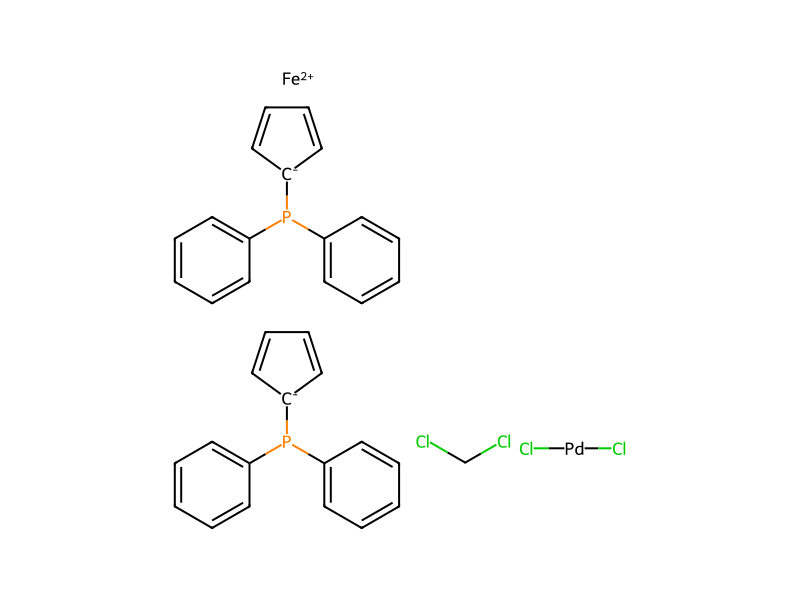
Br[C:2]1[CH:7]=[CH:6][C:5]([CH:8]([N:10]2[CH2:24][CH2:23][C:13]3([O:18][CH2:17][C:16](=[O:19])[N:15]([CH:20]4[CH2:22][CH2:21]4)[CH2:14]3)[CH2:12][CH2:11]2)[CH3:9])=[CH:4][CH:3]=1.CC1(C)C(C)(C)OB([C:33]2[CH:42]=[C:41]3[C:36]([CH:37]=[CH:38][CH:39]=[N:40]3)=[CH:35][CH:34]=2)O1.C(=O)([O-])[O-].[K+].[K+]>O1CCOCC1.C1C=CC(P(C2C=CC=CC=2)[C-]2C=CC=C2)=CC=1.C1C=CC(P(C2C=CC=CC=2)[C-]2C=CC=C2)=CC=1.Cl[Pd]Cl.[Fe+2].C(Cl)Cl>[CH:20]1([N:15]2[CH2:14][C:13]3([CH2:23][CH2:24][N:10]([CH:8]([C:5]4[CH:6]=[CH:7][C:2]([C:33]5[CH:42]=[C:41]6[C:36]([CH:37]=[CH:38][CH:39]=[N:40]6)=[CH:35][CH:34]=5)=[CH:3][CH:4]=4)[CH3:9])[CH2:11][CH2:12]3)[O:18][CH2:17][C:16]2=[O:19])[CH2:22][CH2:21]1
참가 물질실험 절차후처리출처 및 근거반응 노트

참가 물질

6

반응물 3

HCID 11430Potassium CarbonateHCID 592961167-(4,4,5,5-tetramethyl-1,3,2-dioxaborolan-2-yl)QuinolineHCID 712708649-(1-(4-Bromophenyl)ethyl)-4-cyclopropyl-1-oxa-4,9-diazaspiro[5.5]undecan-3-one

생성물 1

HCID 712708024-Cyclopropyl-9-(1-(4-(quinolin-7-yl)phenyl)ethyl)-1-oxa-4,9-diazaspiro[5.5]undecan-3-one수율 19.8%

시약·촉매·용매 2

HCID 178418807
HCID 178418807, 화합물
촉매
HCID 312751,4-Dioxane용매

실험 절차

A solution of 9-[1-(4-bromophenyl)ethyl]-4-cyclopropyl-1-oxa-4,9-diazaspiro[5.5]undecan-3-one (0.297 mmol) in 1,4-dioxane (1.5 mL) was treated with 7-(4,4,5,5-tetramethyl-1,3,2-dioxaborolan-2-yl)quinoline (0.329 mmol), PdCl2(dppf)-CH2Cl2 adduct (0.015 mmol) and 2M aq potassium carbonate (0.892 mmol). The reaction vessel was purged with nitrogen and sealed, and the mixture was irradiated in a Biotage Initiator Microwave at 150° C. for 20 min. The resulting black mixture was diluted with water (50 mL) and extracted three times with dichloromethane. The combined organic layers were treated with Silicycle Si-thiol (20 mg), dried over sodium sulfate, filtered and concentrated in vacuo. The resulting crude product was purified by silica gel chromatography (4-10% methanol/dichloromethane) and then by reverse phase HPLC (5-35% acetonitrile with 0.1% TFA/water with 0.1% TFA). Fractions containing the desired product were combined and the pH of the resulting mixture was adjusted to ˜11 with 30% w/v ammonium hydroxide solution. This mixture was concentrated to a minimal volume in vacuo and was then extracted three times with dichloromethane. The combined organic layers were dried over sodium sulfate, filtered and concentrated in vacuo. Lyophilization of the resulting semi-solid from water yielded the title compound as a white solid (26 mg, 18%). MS(ES)+ m/e 442.1 [M+H]+.

후처리

  1. customThe reaction vessel was purged with nitrogen
  2. customsealed
  3. customthe mixture was irradiated in a Biotage Initiator Microwave at 150° C. for 20 min
  4. additionThe resulting black mixture was diluted with water (50 mL)
  5. extractionextracted three times with dichloromethane
  6. additionThe combined organic layers were treated with Silicycle Si-thiol (20 mg)
  7. dry with materialdried over sodium sulfate
  8. filtrationfiltered
  9. concentrationconcentrated in vacuo
  10. customThe resulting crude product was purified by silica gel chromatography (4-10% methanol/dichloromethane)
  11. additionFractions containing the desired product
  12. concentrationThis mixture was concentrated to a minimal volume in vacuo
  13. extractionwas then extracted three times with dichloromethane
  14. dry with materialThe combined organic layers were dried over sodium sulfate
  15. filtrationfiltered
  16. concentrationconcentrated in vacuo

출처 및 근거

ORD 기록
ord-c722b3c977b34e749e2d78602b6fb019
출처 데이터셋
uspto-grants-2015_07
DOI
10.6084/m9.figshare.5104873.v1
특허 번호
US09084794B2

반응 노트

이 페이지에서참가 물질실험 절차후처리출처 및 근거반응 노트