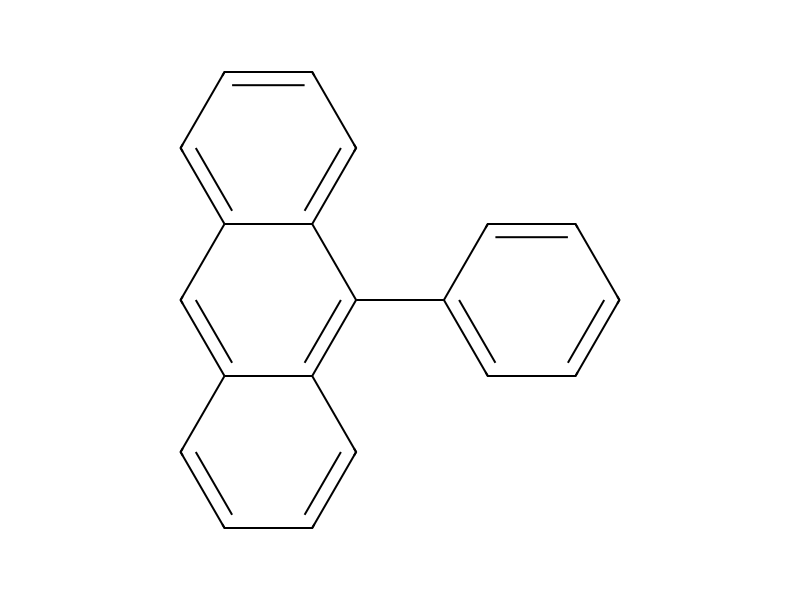
9-Phenylanthracene → 9-Bromo-10-phenyl-anthracene
반응식

[C:1]1([C:7]2[C:8]3[C:13]([CH:14]=[C:15]4[C:20]=2[CH:19]=[CH:18][CH:17]=[CH:16]4)=[CH:12][CH:11]=[CH:10][CH:9]=3)[CH:6]=[CH:5][CH:4]=[CH:3][CH:2]=1.[Br:21]Br.O.S([O-])([O-])(=O)=S.[Na+].[Na+]>C(Cl)(Cl)(Cl)Cl>[Br:21][C:14]1[C:15]2[C:20]([C:7]([C:1]3[CH:2]=[CH:3][CH:4]=[CH:5][CH:6]=3)=[C:8]3[C:13]=1[CH:12]=[CH:11][CH:10]=[CH:9]3)=[CH:19][CH:18]=[CH:17][CH:16]=2참가 물질
5




실험 절차
6.0 g (23.7 mmol) of 9-phenylanthracene was dissolved in 80 ml of carbon tetrachloride, and a solution in which 3.80 g (21.1 mmol) of bromine was dissolved in 10 ml of carbon tetrachloride was dropped into the reaction solution by a dropping funnel. After the dropping, stirring was conducted for 1 hour at room temperature. After reaction, a sodium thiosulfate water solution was added and the reaction was stopped. An organic layer was washed with an NaOH water solution and a saturated saline and dried with magnesium sulfate. After the natural filtration, it was concentrated, dissolved in toluene, and filtered through florisil, Celite (registered trademark), and alumina. The filtrate was concentrated and recrystallized by dichloromethane and hexane. Then, 7.0 g of a light-yellow solid of 9-bromo-10-phenylanthracene, which was the intended object, was obtained with a yield of 89% (synthetic scheme of (b-4)).