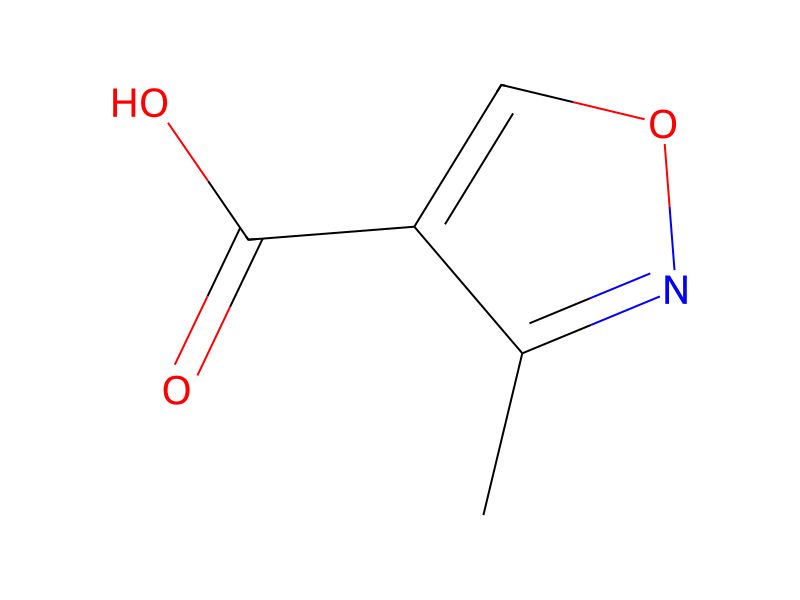
C(Cl)(=O)C(Cl)=O.[CH3:7][C:8]1[C:12]([C:13]([OH:15])=O)=[CH:11][O:10][N:9]=1.[N:16]1([CH2:22][CH2:23][O:24][C:25]2[CH:30]=[CH:29][C:28]([C:31]34[NH:43][CH2:42][CH2:41][N:32]3[C:33](=[O:40])[C:34]3[N:35]([CH:37]=[CH:38][CH:39]=3)[CH2:36]4)=[CH:27][CH:26]=2)[CH2:21][CH2:20][O:19][CH2:18][CH2:17]1.O>CN(C=O)C.C(Cl)Cl.N1C=CC=CC=1>[CH3:7][C:8]1[C:12]([C:13]([N:43]2[C:31]3([C:28]4[CH:29]=[CH:30][C:25]([O:24][CH2:23][CH2:22][N:16]5[CH2:17][CH2:18][O:19][CH2:20][CH2:21]5)=[CH:26][CH:27]=4)[CH2:36][N:35]4[CH:37]=[CH:38][CH:39]=[C:34]4[C:33](=[O:40])[N:32]3[CH2:41][CH2:42]2)=[O:15])=[CH:11][O:10][N:9]=1To generate the acid chloride, oxalyl chloride (0.1 mL, 1.2 mmol) and DMF (1 drop) were added to 3-methyl-1,2-oxazole-4-carboxylic acid (30 mg, 0.24 mmol) in CH2Cl2 (0.5 mL) at 0° C. The suspension was allowed to stir 15 minutes at 0° C. followed by 1 hour at room temperature. The resulting solution was concentrated to give an oil that was further dried under nitrogen. To a chilled suspension of the acid chloride (generated as above, 0.24 mmol) in pyridine (0.5 mL) was added 10a-{4-[2-(morpholin-4-yl)ethoxy]phenyl}-2,3,10,10a-tetrahydro-1H,5H-imidazo[1,2-a]pyrrolo[1,2-d]pyrazin-5-one (20 mg, 75% pure, 0.039 mmol) in pyridine (0.3 mL). The reaction mixture was stirred at 0° C. and then at room temperature. After 2.5 hours an additional batch of acid chloride (0.24 mmol) was prepared as above, diluted in pyridine (0.3 mL) and added to the reaction mixture. The mixture was stirred overnight at room temperature. Water (2 mL) was then added and the mixture extracted with dichloromethane (3×1.5 mL). The organic layers were dried (MgSO4), filtrated and concentrated in vacuo to give a residue that was purified by preparative LCMS (reverse phase, acetonitrile-water containing 0.1% formic acid) to give 1-[(3-methyl-1,2-oxazol-4-yl)carbonyl]-10a-{4-[2-(morpholin-4-yl)ethoxy]phenyl}-2,3,10,10a-tetrahydro-1H,5H-imidazo[1,2-a]pyrrolo[1,2-d]pyrazin-5-one (110) (7 mg, yield 36%).
불러오는 중…