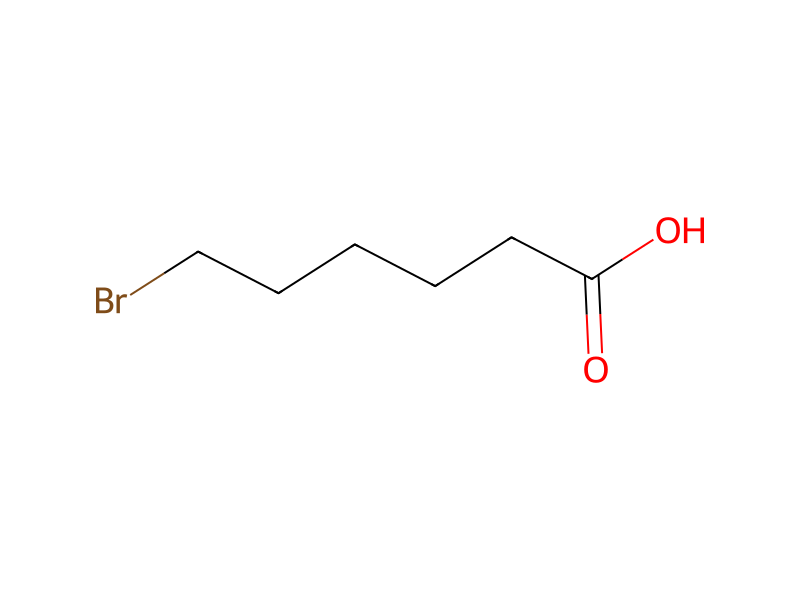
6-Bromohexanoic acid → 6-Bromohexanamide
반응식

N[C:2]1[C:3](=[O:12])[NH:4]C=[C:6]([C:8](OC)=O)[CH:7]=1.[Br:13][CH2:14]CCCCC(O)=O>>[Br:13][CH2:14][CH2:8][CH2:6][CH2:7][CH2:2][C:3]([NH2:4])=[O:12]참가 물질


실험 절차
Solid phase synthesis has been employed in the preparation of certain pyridinones. In Solid Phase Synthesis of 1,3,5-Trisubstituted Pyridin-2-ones, Tetrahedron Letters, 40(1999) 2227-2230 authors James A. Linn et al. report the solid phase synthesis of 1,3,5-trisubstituted pyridin-2-ones via selective NH-alkylation of 3-amino-5-carbomethoxy-1H-pyridin-2-one using a solid supported halo-acid. The synthesis proceeds by the coupling of 6-bromohexanoic acid to a Rink amine macrocrown to form a solid-supported 6-bromohexanamide. The solid-supported 6-bromohexanamide was used to alklylate 3-amino-5-carbomethoxy-1H-pyridin-2-one which was then reacted with diphenylacetic acid. Saponification of the resulting ester yielded a solid supported carboxylic acid. Treatment of the solid supported carboxylic acid with pentafluorophenol provided the pentafluorophenyl ester, which when treated with benzylamine was cleaved from the macrocrown to give the pyridinone. However, a solid phase synthesis procedure to produce ring fused 2-pyridinones has not yet been reported.
후처리
- customSolid phase synthesis
출처 및 근거
- ORD 기록
- ord-aa938cd3eeb742ed824537950df2de88
- 출처 데이터셋
- uspto-grants-2005_01
- 특허 번호
- US06841559B1
반응 노트
불러오는 중…