Triethylamine → 1-(5-(Methylsulfanyl)pyridin-2-yl)ethan-1-one
HRID 1767705
반응식

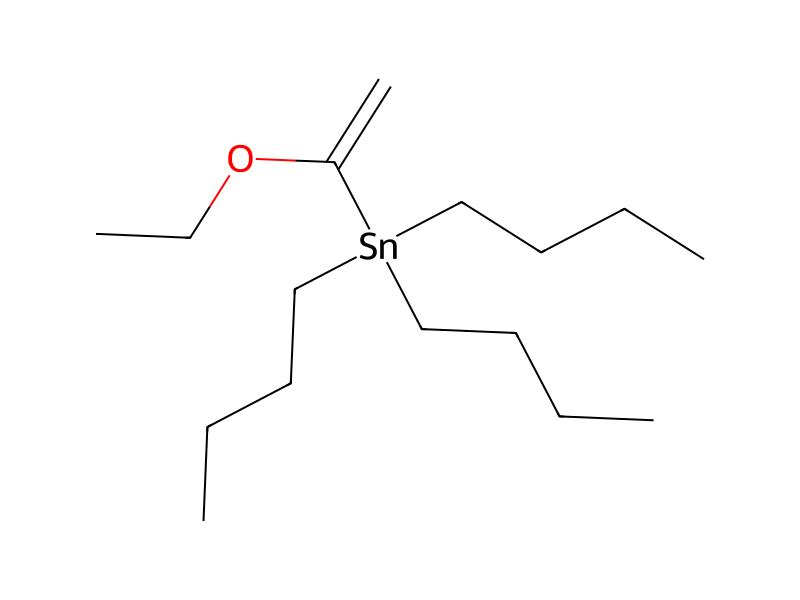
Br[C:2]1[CH:7]=[CH:6][C:5]([S:8][CH3:9])=[CH:4][N:3]=1.C(N(CC)CC)C.[CH2:17]([O:19]C([Sn](CCCC)(CCCC)CCCC)=C)[CH3:18]>O1CCOCC1>[CH3:9][S:8][C:5]1[CH:6]=[CH:7][C:2]([C:17](=[O:19])[CH3:18])=[N:3][CH:4]=1참가 물질
5




실험 절차
To a stirring solution of 2-bromo 5-methylsulfanyl pyridine (3.05 g 14.9 mmol), triethylamine (2.10 mL, 14.9 mmol) and (1-ethoxyvinyl)tributyl tin (10.1 mL, 29.8 mmol) in anhydrous 1,4-dioxane (100 mL), was added dichlorobis(triphenylphosphine) palladium (II) (5 mol %, 0.524 g) and the reaction heated to reflux under nitrogen for 18 hours. After cooling, dichlorobis(triphenylphosphine) palladium (II) was added and the reaction heated under nitrogen for a further 18 hours. The reaction was allowed to cool and-the reaction mixture partitioned between saturated aqueous potassium fluoride solution (250 mL) and diethyl ether (250 mL). The ether layer was separated and 2N hydrochloric acid (250 mL) added. The acid layer was separated and sodium carbonate added portionwise until the solution reached pH 8. The solution was extracted with dichloromethane (3×200 mL). The organic extracts were combined and the solvent removed. The residue was partitioned between cyclohexane (60 ml) and acetonitrile (60 mL). The acetonitrile layer was separated and the solvent removed to yield a brown solid. The crude product was purified by flash column chromatography (cyclohexane:ethyl acetate, 95:5) to afford the title compound as a white solid: