O-Phenylenediamine → 1,2-Bis(benzimidazol-2-yl)-1,1,2,2-tetrafluoroethane
HRID 1781966
반응식

[C:1]1([NH2:8])[CH:6]=[CH:5][CH:4]=[CH:3][C:2]=1[NH2:7].[F:9][C:10]([F:20])([C:17](O)=O)[C:11]([F:16])([F:15])[C:12](O)=O>>[N:7]1[C:2]2[CH:3]=[CH:4][CH:5]=[CH:6][C:1]=2[NH:8][C:12]=1[C:11]([F:16])([F:15])[C:10]([C:17]1[NH:7][C:2]2[CH:3]=[CH:4][CH:5]=[CH:6][C:1]=2[N:8]=1)([F:20])[F:9]참가 물질
3
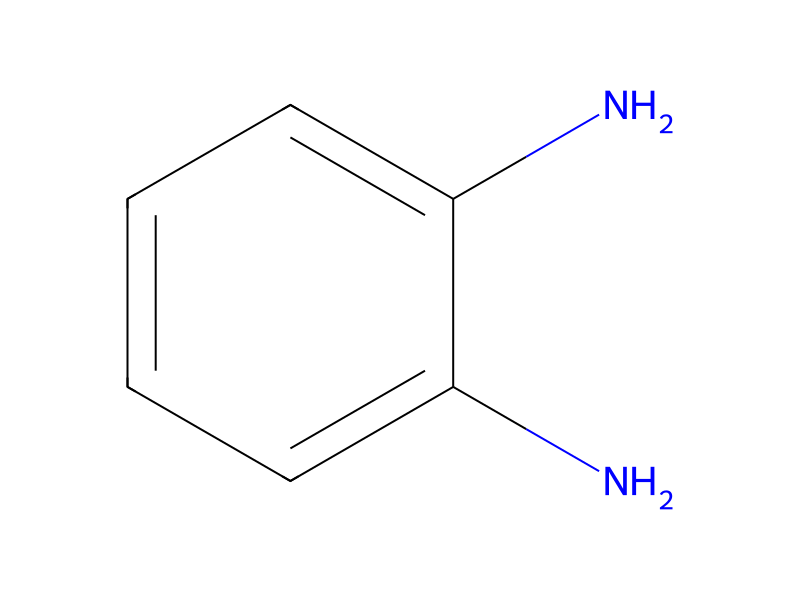


반응 조건
- 온도
- 160 °C
실험 절차
In a 250 mL 35/25 ball joint flask, 1,2-phenylenediamine (5.92 g, 54.7 mmol) was combined with tetrafluorosuccinic acid (5.2 g, 27.36 mmol). Polyphosphoric acid (83 g) was added directly to the solid mixture. The flask was fitted with an air-driven mechanical stirring shaft and heated to 160° C. under a nitrogen purge maintained with a septum and needle. The molten mixture was stirred for 7 hours and subsequently poured slowly into a large (1 L) excess of cold water. A Waring™ blender was used to grind the solid product/water slurry. The water was then neutralized to a pH of ˜8 with ammonium hydroxide. The brown particulate product, 1,2-bis(benzimidazol-2-yl)-1,1,2,2-tetrafluoroethane, was isolated by filtration, dried in a vacuum oven, ground to a fine powder with a mortar and pestle, and once again slurried in ca. 1 L water which was then neutralized to pH 8 with ammonium hydroxide. The solid was again collected by filtration and dried under diffusion pump vacuum at 110° C. for several days (7.96 g, 87%; C16H10F4N4, FW=334.27). A small amount of water was still present by 1H NMR (br s, 3.35 ppm). 1H NMR (d6-DMSO): δ 13.66 (br s, 2 H, NH), 7.67 and 7.34 (each br s, 4 H, aryl C—H. 13C{1H} NMR (solid state): δ 142.2, 135.5 (C—N), 124.2, 120.2, 114.4 (aryl) (C═N and CF2 not observed). 19F NMR (d6-DMSO, vs. CFCl3): δ −110.61. IR (KBr pellet, cm−1): 3063 (m), 3011 (m), 2947 (m), 2864 (s), 2749 (s), 2699 (sh), 2647 (s), 2546 (m), 2527 (m), 1942 (w), 1903 (w), 1778 (w), 1622 (w), 1591 (m), 1537 (w), 1492 (m), 1456 (s), 1441 (s), 1389 (w), 1317 (m), 1279 (m), 1231 (m), 1202 (w), 1161 (vs), 1140 (vs), 1030 (m), 1014 (m), 999 (m), 941 (m), 909 (m), 887 (m), 789 (w), 766 (w), 739 (s), 675 (w), 619 (w), 590 (m), 545 (w), 434 (m). Elemental analysis calculated for C16H10F4N4: C, 57.49; H, 3.02; F, 22.73; N, 16.76. Found: C, 56.74; H, 2.82; F, 21.95; N, 16.70. FD-MS m/z (%): 334 (M+, 100), 167 (C8H5F2N2, 6). Melting point (DSC, maximum): 383° C.