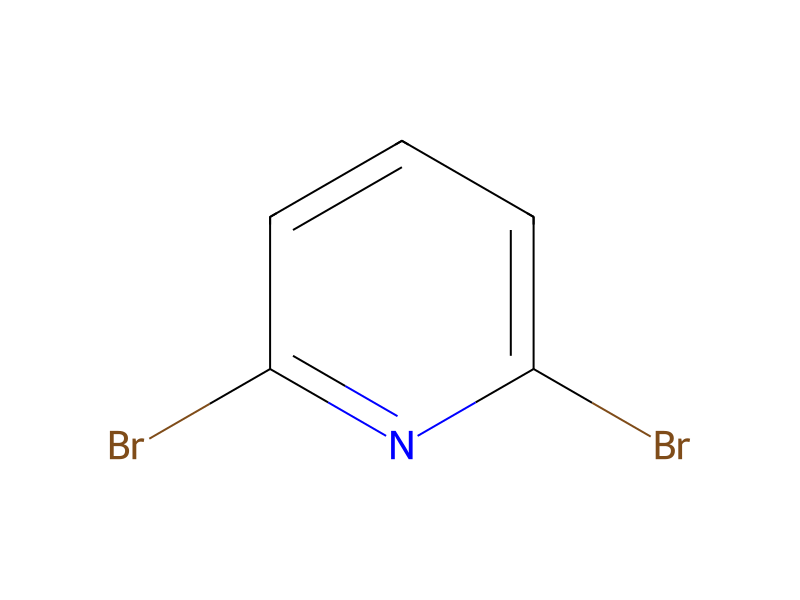
2,6-Dibromopyridine → 2-Bromo-6-cyclopentylpyridine
반응식

Br[C:2]1[CH:7]=[CH:6][CH:5]=[C:4]([Br:8])[N:3]=1.[Br-].[CH:10]1([Zn+])[CH2:14][CH2:13][CH2:12][CH2:11]1>C(OCC)(=O)C.C1C=CC([P]([Pd]([P](C2C=CC=CC=2)(C2C=CC=CC=2)C2C=CC=CC=2)([P](C2C=CC=CC=2)(C2C=CC=CC=2)C2C=CC=CC=2)[P](C2C=CC=CC=2)(C2C=CC=CC=2)C2C=CC=CC=2)(C2C=CC=CC=2)C2C=CC=CC=2)=CC=1>[Br:8][C:4]1[CH:5]=[CH:6][CH:7]=[C:2]([CH:10]2[CH2:14][CH2:13][CH2:12][CH2:11]2)[N:3]=1참가 물질
5




실험 절차
To 2,6-dibromopyridine (5.9 g, 25 mmol) and tetrakis(triphenylphosphine)palladium(0) (1.4 g, 1.2 mmol) was added cyclopentylzinc bromide (50 ml, 0.5 M solution in tetrahydrofuran) and the mixture heated at reflux for 18 h. The reaction was diluted with ethyl acetate and washed with water. The organic phase was separated, dried over magnesium sulfate, filtered and evaporated in vacuo to give an oil. The crude product was chromatographed on silica, eluting on a gradient from 1 to 5% methanol in dichloromethane, to give 2-bromo-6-cyclopentylpyridine (3.25 g) as a white solid: δH (400 MHz, CDCl3) 1.60-1.90 (6H, m), 2.09 (2H, m), 3.17 (1H, m), 7.12 (1H, d, J 7.4), 7.28 (1H, d, J 7.4), 7.44 (1H, t, J 7.2); m/z (ES+) 226:228 (1:1) (M++H).
후처리
- temperaturethe mixture heated
- temperatureat reflux for 18 h
- washwashed with water
- customThe organic phase was separated
- dry with materialdried over magnesium sulfate
- filtrationfiltered
- customevaporated in vacuo
- customto give an oil
- customThe crude product was chromatographed on silica
- washeluting on a gradient from 1 to 5% methanol in dichloromethane
출처 및 근거
- ORD 기록
- ord-a25407265d444a9bb3742ca2e2d2d71a
- 출처 데이터셋
- uspto-grants-2006_04
- 특허 번호
- US07030128B2
반응 노트
불러오는 중…