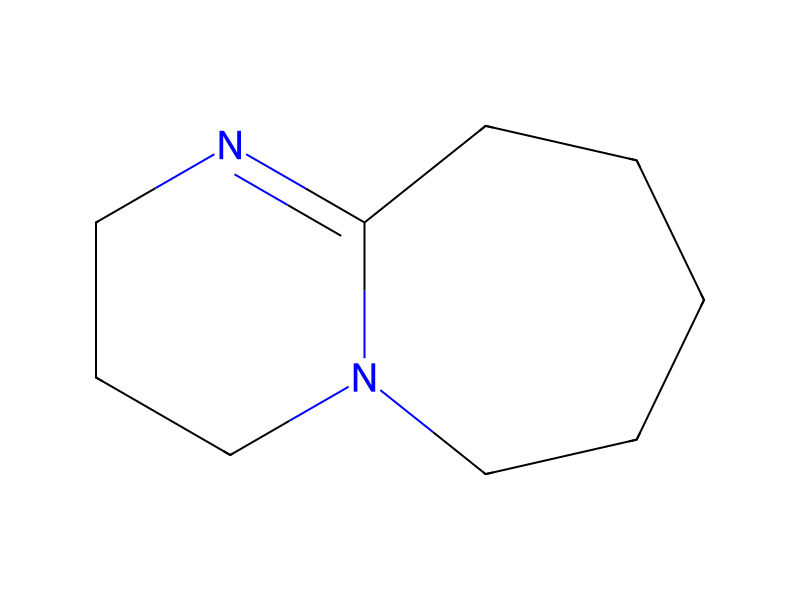
[OH:1][CH2:2][C:3]1[CH:4]=[N:5][CH:6]=[C:7]2[C:12]=1[N:11]=[CH:10][CH:9]=[CH:8]2.C1C=CC(P([N:27]=[N+:28]=[N-:29])(C2C=CC=CC=2)=O)=CC=1.[CH2:30]1[CH2:40][CH2:39][N:38]2[C:33](=[N:34][CH2:35][CH2:36][CH2:37]2)[CH2:32][CH2:31]1>CCOC(C)=O>[OH:1][CH2:2][C:3]1[CH:4]=[N:5][CH:6]=[C:7]2[C:12]=1[N:11]=[CH:10][CH:9]=[CH:8]2.[N:27]([CH2:30][C:40]1[CH:39]=[N:38][CH:37]=[C:36]2[C:35]=1[N:34]=[CH:33][CH:32]=[CH:31]2)=[N+:28]=[N-:29]To a solution of 0.93 g (5.8 mmol) 8-hydroxymethyl-1,6-napthyridine in 20 mL TBF was added 1.5 mL (7 mmol) DPPA and 1.2 mL (6.7 mmol) DBU. The reaction mixture was allowed to stir at room temperature 18 hours, then another 0.3 mL DPPA and 0.25 mL DBU were added and the reaction mixture heated to 50° C. for 8 hours then cooled to room temperature then another 0.3 mL DPPA and 0.25 mL DBU were added and the reaction mixture was allowed to stir 18 more hours at room temperature. The resulting solution was then diluted with 200 L EtOAc, washed with saturated NaHCO3 solution, and brine, dried over Na2SO4, filtered and concentrated in vacuo. Purification by flash chromatography (40×120 mm silica gel, linear gradient 2-15% MeOH:CH2Cl2) yielded 8-hydroxymethyl-1,6-napthyridine and 8-azidomethyl-1,6-napthyridine. 1H NMR (CDCl3, 400 MHz) δ 9.30 (s, 1H); 9.16 (dd, 1H, J=4.3 and 1.8 Hz); 8.78 (s, 1H); 8.35 (dd, 1H, J=8.3 and 1.74 Hz); 7.61 (dd, 1H, J=8.3 and 4.3 Hz); 5.00 (s, 2H).