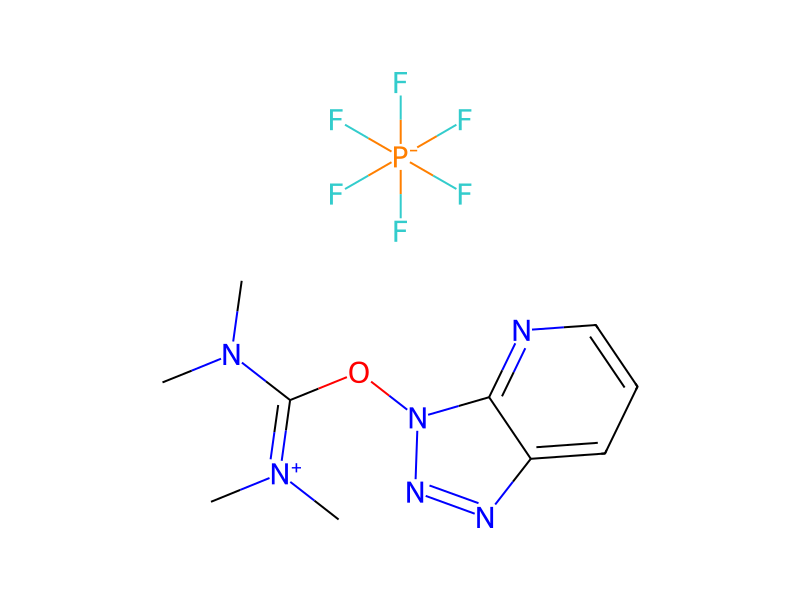
To a stirred mixture of 2-bromothiazole-5-carboxylic acid (500 mg, 2.4 mmol) in anhydrous N,N-dimethylformamide (5 mL) was added triethylamine (1.1 mL, 7.92 mmol), HATU (1 g, 2.64 mmol), and 4-((4-aminopiperidin-1-yl)methyl)benzonitrile (762 mg, 2.64 mmol). The mixture was stirred at room temperature overnight and then poured into water. The resulting solids were collected by filtration and purified by column chromatography to yield 972 mg (100%) of 2-bromo-N-(1-(4-cyanobenzyl)piperidin-4-yl)thiazole-5-carboxamide as a yellow solid. LCMS (m/z): 406 (MH+).