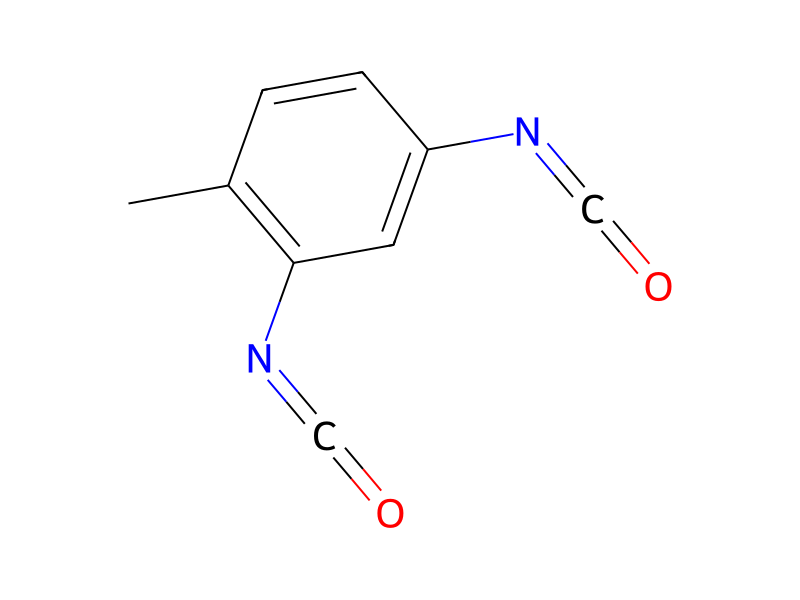
Toluene 2,4-Diisocyanate → Dimethylthiotoluenediamine
반응식

CC1C(=CC(=CC=1)N=C=O)[N:4]=C=O.[CH3:14][S:15][C:16]1[CH:21]=[C:20]([CH3:22])[C:19]([NH2:23])=[C:18]([S:24][CH3:25])[C:17]=1N>>[CH3:22][C:20]1[C:21]([NH2:4])=[C:16]([S:15][CH3:14])[CH:17]=[C:18]([S:24][CH3:25])[C:19]=1[NH2:23]참가 물질


실험 절차
To a glass kettle there were added 80.76 g of a polytetramethylene glycol/polypropylene glycol based resin end-capped with an excess of toluene diisocyanate, obtained from Dow Chemical Company, 18.0 g of bis[oxydiethylenebis(polycaprolactone)yl]-5-methyltriphenylphosphoniumsulfo-1,3-benzenedicarboxylate, three drops of a polydimethylsiloxane anti-foam agent obtained from Union Carbide Company as SAG 47™, and 21.5 g of di(methylthio)-2,4-toluenediamine, an aromatic diamine sold by and obtained from Ethyl Corporation under the tradename Ethacure 300. The reaction mixture was stirred at room temperature, under nitrogen, for four minutes, degassed under reduced pressure (0.01 mm Hg) and poured into a stainless steel mold. The polymer was cured at 100° C. for sixteen hours and demolded. The slab was then cooled to room temperature and the resistiviities of the slab molded to a thickness of 0.25 in (0.635 cm) were measured as described above at the two designated relative humidities and the relative humidity sensitivity was determined after an equilibration time of fourteen days in a relative humidity chamber. The results are shown in Table I, Example 5 below.
출처 및 근거
- ORD 기록
- ord-cabc526893b24683bfca99183b63c95d
- 출처 데이터셋
- uspto-grants-1996_11
- 특허 번호
- US05571457
반응 노트
불러오는 중…