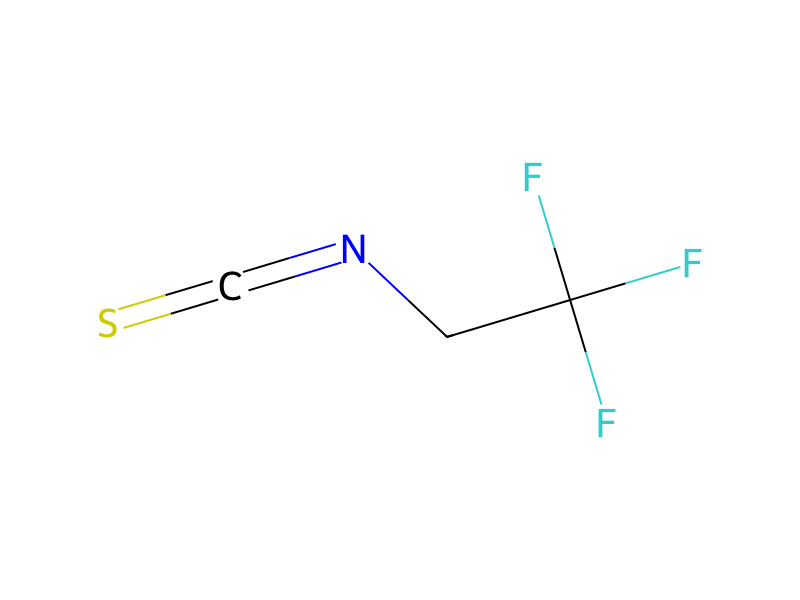
1,1,1-Trifluoro-2-isothiocyanatoethane → 4-[2-(2,2,2-Trifluoroethyl)guanidino]-2-[4-(3-(2,2,2-trifluoroethyl)thioureido)butyl]pyrimidine
HRID 1902267
반응식

[F:1][C:2]([F:8])([F:7])[CH2:3][N:4]=[C:5]=[S:6].[F:9][C:10]([F:28])([F:27])[CH2:11][N:12]=[C:13]([NH2:26])[NH:14][C:15]1[CH:20]=[CH:19][N:18]=[C:17]([CH2:21][CH2:22][CH2:23][CH2:24][NH2:25])[N:16]=1>C(#N)C>[F:28][C:10]([F:9])([F:27])[CH2:11][N:12]=[C:13]([NH2:26])[NH:14][C:15]1[CH:20]=[CH:19][N:18]=[C:17]([CH2:21][CH2:22][CH2:23][CH2:24][NH:25][C:5]([NH:4][CH2:3][C:2]([F:8])([F:7])[F:1])=[S:6])[N:16]=1참가 물질
4



실험 절차
2,2,2-Trifluoroethylisothiocyanate (0.31 g.) was added to a solution of 4-[2-(2,2,2-trifluoroethyl)-guanidino]-2-(4-aminobutyl)pyrimidine (0.58 g.) in acetonitrile (5 ml.), and the solution kept at room temperature for 18 hours and then evaporated to dryness. The residual gum was purified by preparative thin layer chromatography using ethyl acetate/methanol/ammonia 6:1:0.5 v/v/v as developing solvent to give 4-[2-(2,2,2-trifluoroethyl)guanidino]-2-[4-(3-(2,2,2-trifluoroethyl)thioureido)butyl]pyrimidine (0.22 g.) characterised as the hydrogen maleate, m.p. 142°-145° (after recrystallisation from acetonitrile).