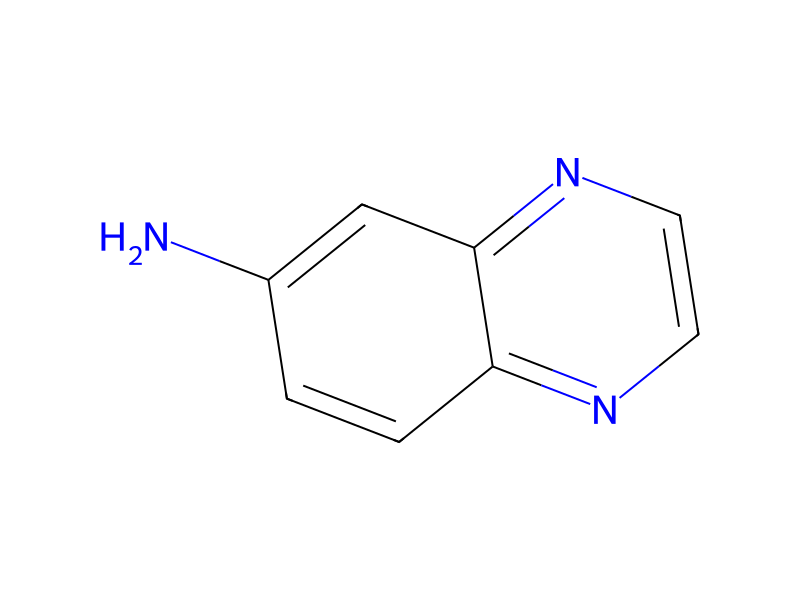
6-Quinoxalinamine → 2-Methylquinoxalin-6-amine
HRID 1941133
반응식

[CH3:1][C:2]1[CH:11]=[N:10][C:9]2[C:4](=[CH:5][CH:6]=[C:7]([N+:12]([O-])=O)[CH:8]=2)[N:3]=1.NC1C=C2C(=CC=1)N=CC=N2>CO>[CH3:1][C:2]1[CH:11]=[N:10][C:9]2[C:4](=[CH:5][CH:6]=[C:7]([NH2:12])[CH:8]=2)[N:3]=1참가 물질
4



실험 절차
A thick-walled Parr hydrogenation flask was charged with 2-methyl-6-nitroquinoxaline (10.0 g, 52.9) and CH3OH (200 ml). The flask was flushed with a stream of nitrogen and 10% by weight palladium on charcoal (500 mg) was added. The flask was pressurized with hydrogen to 50 psi and maintained at this pressure for three (3) hours. The reaction mixture was filtered and washed through silicon dioxide and concentrated in vacuo to yield a tan solid. The crude material was chromatographed (SiO2 ; 95/5 CHCl3 /CH3OH saturated with NH3 (g)) and recrystallized from benzene to yield 7.4 g (a yield of 88%) of a tan solid. Using various analytical procedures, this tan solid was determined to be 2-methyl-,6-aminoquinoxaline.