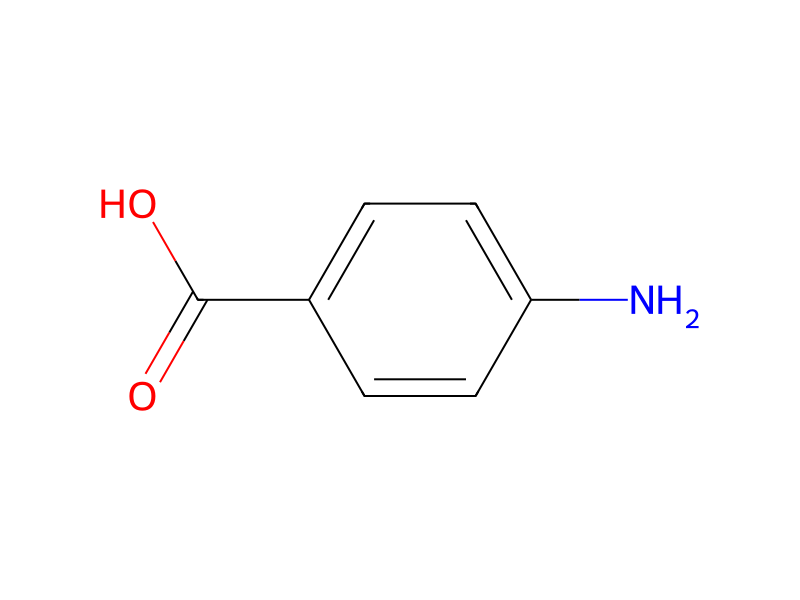
4-Aminobenzoic Acid → 4-(2-Chlorobenzamido)benzoic acid
HRID 1951597
반응식

[NH2:1][C:2]1[CH:10]=[CH:9][C:5]([C:6]([OH:8])=[O:7])=[CH:4][CH:3]=1.[Cl:11][C:12]1[CH:20]=[CH:19][CH:18]=[CH:17][C:13]=1[C:14](Cl)=[O:15].C(N(CC)CC)C>C(#N)C>[Cl:11][C:12]1[CH:20]=[CH:19][CH:18]=[CH:17][C:13]=1[C:14]([NH:1][C:2]1[CH:10]=[CH:9][C:5]([C:6]([OH:8])=[O:7])=[CH:4][CH:3]=1)=[O:15]참가 물질
5




실험 절차
under an N2 atmosphere, 4-aminobenzoic acid (2.50 g, 18.2 mmol) was dissolved in acetonitrile (100 ml) and treated with 2-chlorobenzoyl chloride (2.43 ml, 19.1 mmol). Triethylamine (2.66 ml, 19.1 mmol) was added and the reaction was allowed to stir at room temperature for four hours. The reaction was concentrated in vacuo, and the resulting solid was partitioned between Et2O and 0.5N NaOH. The layers were separated and the organic layer was discarded. The aqueous layer was acidified to pH 2 with HCl and the aqueous layer was extracted with ethyl acetate. The organic layer was dried Na2SO4, filtered and concentrated in vacuo. The resulting solid was triturated with Et2O, and the solid was collected by filtration to afford 4-(2-chlorobenzamido)benzoic acid (2.72 g, 54.2% yield). ESI m/z=276.1 (M+H+).