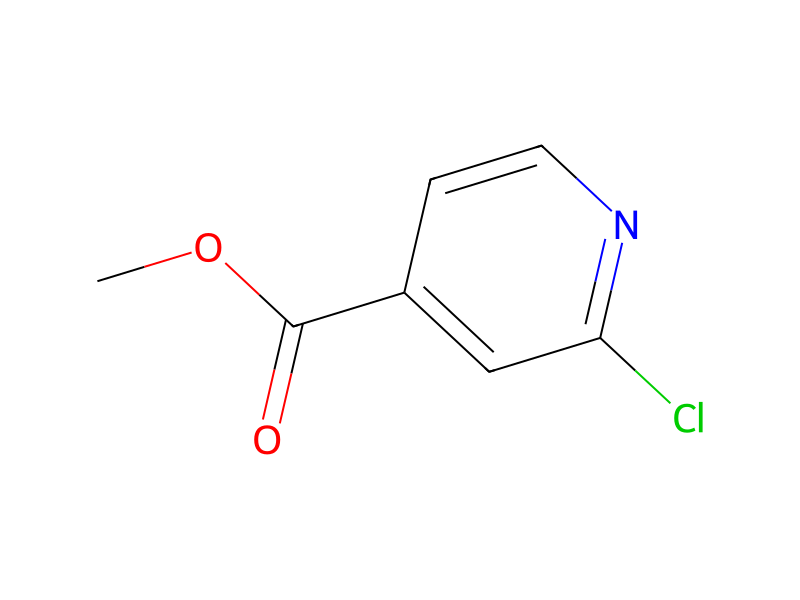
To methyl-2-chloroisonicotinate (1.664 g, 9.7 mmol) and bis(tri-tert-butylphosphine)palladium(0) (198 mg, 0.38 mmol) under nitrogen was added tetrahydrofuran (10 mL). To the resulting solution was added freshly prepared ((4,4-difluorocyclohexyl)methyl)zinc(II) bromide (14.55 mmol, 0.5 M in 29 mL DMA) and the resulting brown mixture heated to 60° C. for 4 h. The reaction mixture was diluted with ethyl acetate and washed with satd NaHCO3 (2 times), satd NH4Cl and brine. The organic layer was dried over MgSO4, filtered and evaporated. The residue was dissolved in DCM and added onto an SCX-2 cation exchange column. The column was washed with DCM, MeOH and then eluted with NH3/MeOH. The NH3/MeOH layer was evaporated leaving methyl 2-((4,4-difluorocyclohexyl)methyl)isonicotinate (2 g, 67%) as a yellow oil. 1H NMR (400 MHz, cdcl3) δ 1.30-1.46 (m, 2H), 1.58-1.79 (m, 4H), 1.87-2.14 (m, 3H), 2.82 (d, 2H), 3.96 (s, 3H), 7.65-7.73 (m, 2H), 8.70 (d, 1H). MS m/z 270 (M+H)+