반응식

[Br:1][C:2]1[CH:7]=[CH:6][C:5]([N:8]=[C:9]=[O:10])=[CH:4][C:3]=1[C:11]([F:14])([F:13])[F:12].[CH3:15][NH:16][C:17]([C:19]1[CH:24]=[C:23]([O:25][C:26]2[CH:32]=[CH:31][C:29]([NH2:30])=[CH:28][CH:27]=2)[CH:22]=[CH:21][N:20]=1)=[O:18]>C(Cl)Cl>[Br:1][C:2]1[CH:7]=[CH:6][C:5]([NH:8][C:9]([NH:30][C:29]2[CH:28]=[CH:27][C:26]([O:25][C:23]3[CH:22]=[CH:21][N:20]=[C:19]([C:17](=[O:18])[NH:16][CH3:15])[CH:24]=3)=[CH:32][CH:31]=2)=[O:10])=[CH:4][C:3]=1[C:11]([F:12])([F:13])[F:14]참가 물질
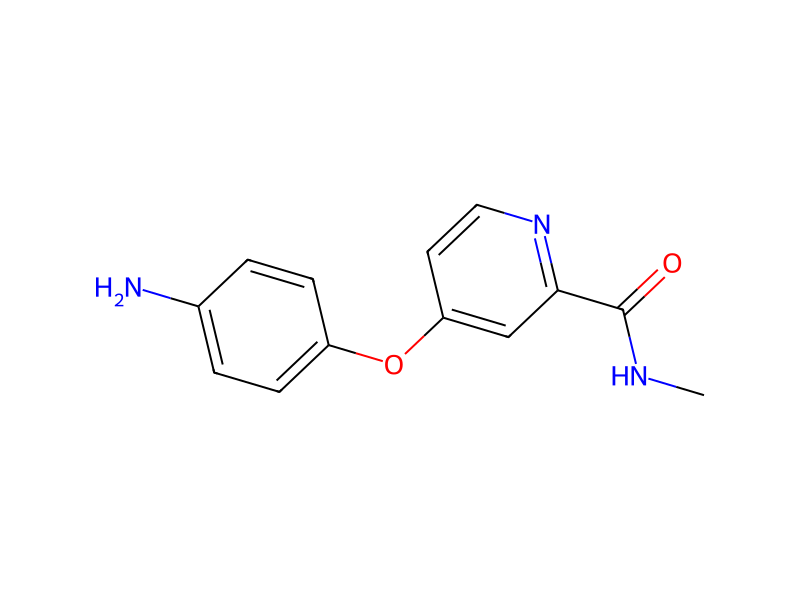



실험 절차
A solution of 4-bromo-3-(trifluoromethyl)phenyl isocyanate (Method B1, Step 2; 8.0 g, 30.1 mmol) in CH2Cl2 (80 mL) was added dropwise to a solution of 4-(2-(N-methylcarbamoyl)-4-pyridyloxy)aniline (Method A2, Step 4; 7.0 g, 28.8 mmol) in CH2Cl2 (40 mL) at 0° C. The resulting mixture was stirred at room temp. for 16 h. The resulting yellow solids were removed by filtration, then washed with CH2Cl2 (2×50 mL) and dried under reduced pressure (approximately 1 mmHg) at 40° C. to afford N-(4-bromo-3-(trifluoromethyl)phenyl)-N′-(4-(2-(N-methylcarbamoyl)-4-pyridyloxy)phenyl) urea as a pale-yellow solid (13.2 g, 90%): mp 203-205° C.; 1H-NMR (DMSO-d6) δ2.77 (d, J=4.8 Hz, 3H), 7.16 (m, 3H), 7.37 (d, J=2.5 Hz, 1H), 7.58 (m, 3H), 7.77 (d, J=8.8 Hz, 1H), 8.11 (d, J=2.5 Hz, 1H), 8.49 (d, J=5.5 Hz, 1H), 8.77 (br d, 1H), 8.99 (s, 1H), 9.21 (s, 1H); HPLC ES-MS m/z 509 ((M+H)+).
후처리
- customThe resulting yellow solids were removed by filtration
- washwashed with CH2Cl2 (2×50 mL)
- customdried under reduced pressure (approximately 1 mmHg) at 40° C.
출처 및 근거
- ORD 기록
- ord-db4776db3aed4270b411124f7a95615e
- 출처 데이터셋
- uspto-grants-2011_04
- 특허 번호
- US07928239B2
연결된 노트
불러오는 중…