Ammonia → HCID 24810091, 화합물
반응식
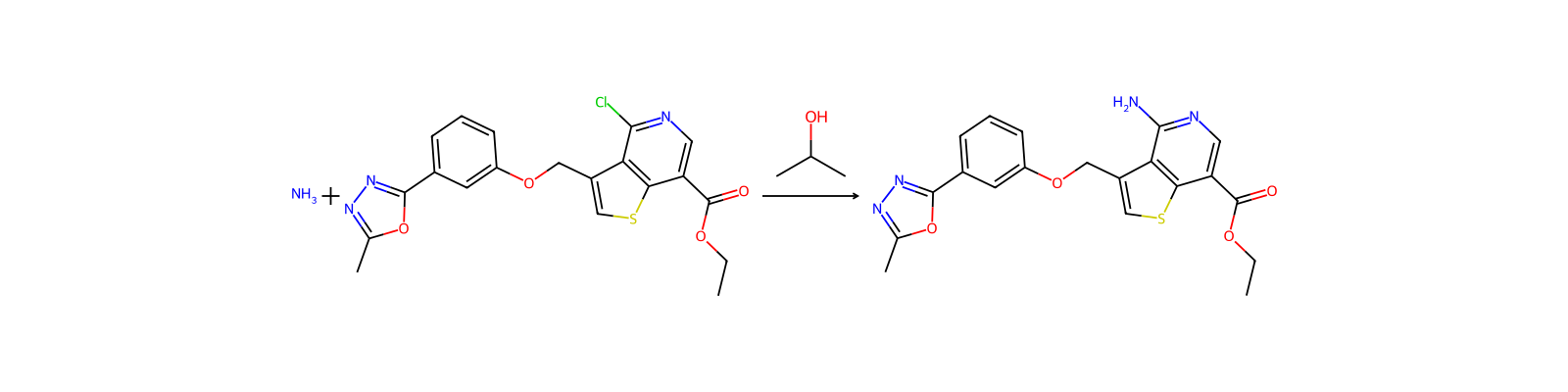
[NH3:1].[CH2:2]([O:4][C:5]([C:7]1[C:8]2[S:16][CH:15]=[C:14]([CH2:17][O:18][C:19]3[CH:24]=[CH:23][CH:22]=[C:21]([C:25]4[O:26][C:27]([CH3:30])=[N:28][N:29]=4)[CH:20]=3)[C:9]=2[C:10](Cl)=[N:11][CH:12]=1)=[O:6])[CH3:3]>CC(O)C>[CH2:2]([O:4][C:5]([C:7]1[C:8]2[S:16][CH:15]=[C:14]([CH2:17][O:18][C:19]3[CH:24]=[CH:23][CH:22]=[C:21]([C:25]4[O:26][C:27]([CH3:30])=[N:28][N:29]=4)[CH:20]=3)[C:9]=2[C:10]([NH2:1])=[N:11][CH:12]=1)=[O:6])[CH3:3]참가 물질
4


반응 조건
- 온도
- 140 °C
실험 절차
Ammonia gas was bubbled into a solution of 4-chloro-3-[3-(5-methyl-[1,3,4]oxadiazol-2-yl)-phenoxymethyl]-thieno[3,2-c]pyridine-7-carboxylic acid ethyl ester (0.12 g, 0.29 mmol) (from Example 8 supra) in 2-propanol (15 mL) for 20 minutes. The mixture was heated in a microwave reactor at 140° C. for 2 hours. The reaction mixture was concentrated. The residue washed with hot methanol, filtered and dried to give 4-amino-3-[3-(5-methyl-[1,3,4]oxadiazol-2-yl)-phenoxymethyl]-thieno[3,2-c]pyridine-7-carboxylic acid ethyl ester. (Yield 0.07 g, 58%).