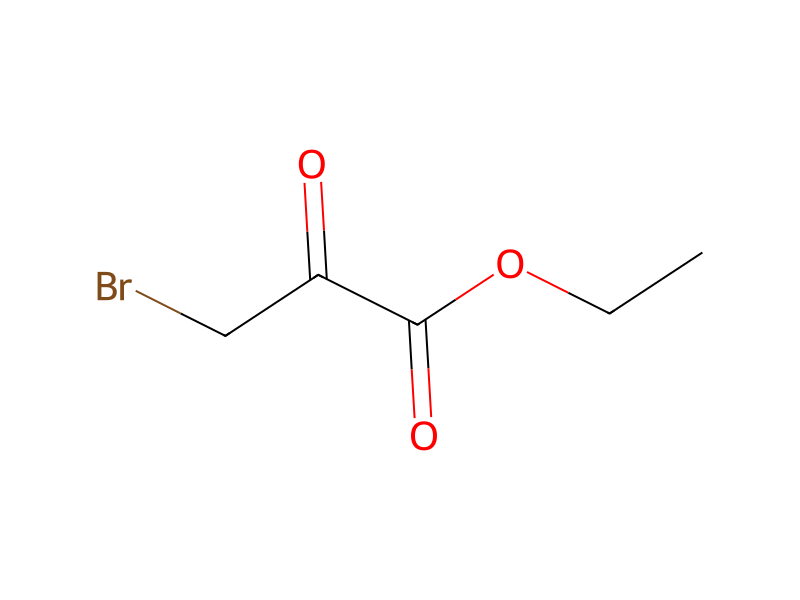
To a solution of 2-mercapto-5-nitrobenzimidazole (195 mg, 1.0 mmol) and ethyl 3-bromopyruvate (0.150 mL, 1.19 mmol) in methanol (2.5 mL) and acetone (2 mL) was added imidazole (68 mg, 1.0 mmol). The resulted solution was shaken at 20° C. for 4 hour. After the removal of solvents under vacuum, the residue was triturated with ethyl ether. The ether phase was discarded. The residue was treated with sodium bicarbonate aqueous solution and ethyl ether. The ether phase was washed successively with sodium bicarbonate aqueous solution, water, and dried over magnesium sulfate. Evaporation to dryness under vacuum gave 200 mg (65% of yield) of the expected product, 3-(5-nitro-1H-benzoimidazol-2-ylsulfanyl)-2-oxo-propionic acid ethyl ester. Proton NMR showed the product was sufficiently pure to be used without further purification. 1H-NMR (D3COD, 300 MHz) δ (ppm): 8.35 and 8.08 (2 br. s, 1H), 8.12 (d, J=8.7 Hz, 1H), 7.50 and 7.28 (2 br. s, 1H), 4.42 (q, J=7.1 Hz, 2H), 4.41 (br. s, 1H), 4.06 (br. s, 1H), 1.30 (t, J=7.1 Hz, 3H). MS (ESI) m/z: 310 (M+1, 100).