반응식

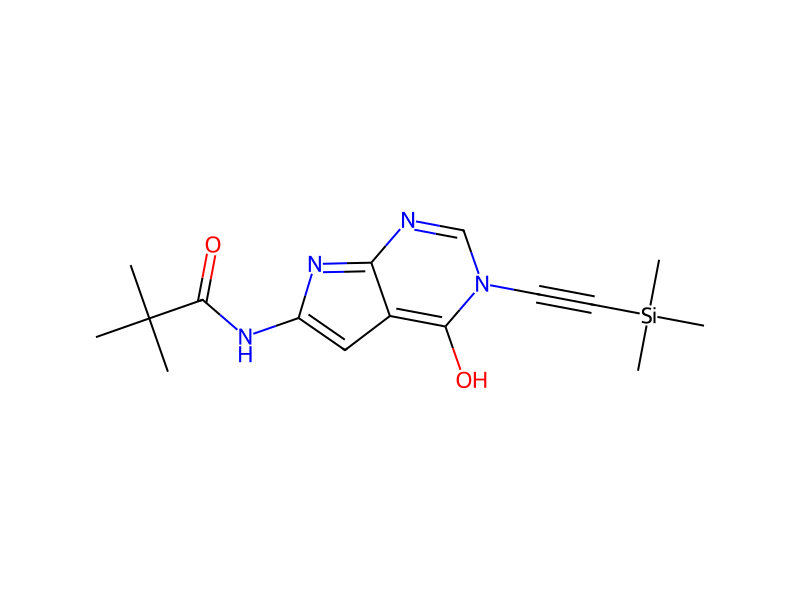
C[Si]([C:5]#[C:6][N:7]1[C:12]([OH:13])=[C:11]2[CH:14]=[C:15]([NH:17][C:18](=[O:23])[C:19]([CH3:22])([CH3:21])[CH3:20])[N:16]=[C:10]2[N:9]=[CH:8]1)(C)C.[F-].C([N+](CCCC)(CCCC)CCCC)CCC>O1CCCC1>[C:6]([N:7]1[C:12]([OH:13])=[C:11]2[CH:14]=[C:15]([NH:17][C:18](=[O:23])[C:19]([CH3:21])([CH3:20])[CH3:22])[N:16]=[C:10]2[N:9]=[CH:8]1)#[CH:5]참가 물질
4



실험 절차
To a solution of 1.5 g of 3-trimethylsilylethynyl-4-hydroxy-6-pivaloylaminopyrrolo[2,3-d]pyrimidine in 100 mL of anhydrous tetrahydrofuran cooled to 0° C. are added under nitrogen 4.75 mL of 1M tetrabutylammonium fluoride in anhydrous tetrahydrofuran. After 5 minutes, the reaction mixture is allowed to attain room temperature and is then stirred for 2 hours. The solvent is removed under reduced pressure and the residue purified by chromatography over silica gel to yield 3-ethynyl-4-hydroxy-6-pivaloylaminopyrrolo[2,3-d]pyrimidine.
후처리
- customto attain room temperature
- customThe solvent is removed under reduced pressure
- customthe residue purified by chromatography over silica gel
출처 및 근거
- ORD 기록
- ord-17e3de88c2ae4027a32974bee729ee29
- 출처 데이터셋
- uspto-grants-1994_09
- 특허 번호
- US05344932
연결된 노트
불러오는 중…