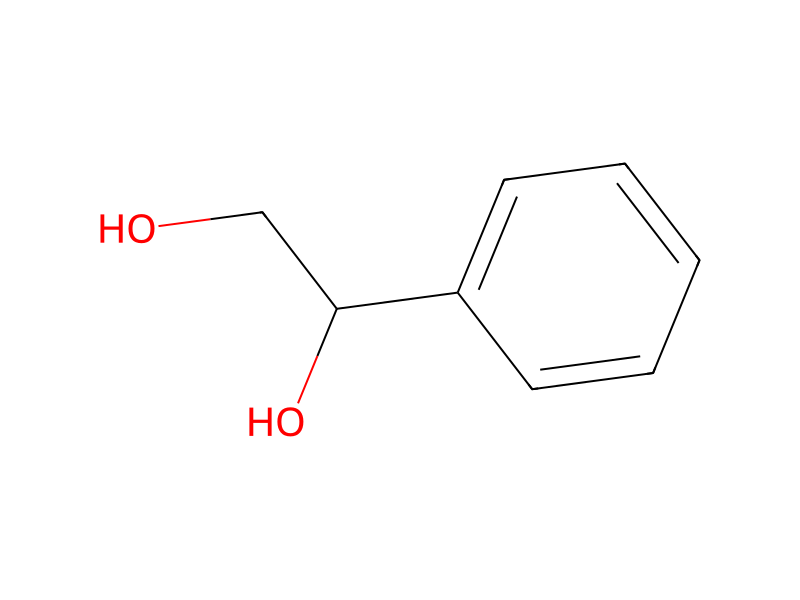
1-Phenyl-1,2-ethanediol → 1,2-Hexanediol
반응식

ClCC(O)[CH2:4][OH:5].ClC(Cl)(Cl)C(C(Cl)(Cl)Cl)=O.[CH:17]1[CH:22]=[CH:21][C:20]([CH:23]([OH:26])[CH2:24][OH:25])=[CH:19][CH:18]=1>>[C:4]1(=[O:5])[O:25][CH2:24][CH:23]([C:20]2[CH:21]=[CH:22][CH:17]=[CH:18][CH:19]=2)[O:26]1.[CH2:24]([OH:25])[CH:23]([OH:26])[CH2:20][CH2:19][CH2:18][CH3:17]참가 물질
5


실험 절차
Similarly, 1,2-butanediol and 2,3-butanediol were heated with equivalent quantities of hexachloroacetone in the presence of K2CO3 or other such basic catalyst as previously defined to produce comparable yields of 1,2-butylene carbonate and 2,3-butylene carbonate, respectively. Also, 3-chloro-1,2-propanediol was reacted in this way with hexachloroacetone to make 4-(chloromethyl)-1,3-dioxol-2-one (chloromethylethylene carbonate). In the same way, styrene glycol (1-phenyl-1,2-ethanediol) is reacted with hexachloroacetone in the presence of a basic catalyst to produce 1-phenylethylene carbonate (4-phenyl-1,3-dioxol-2-one), 1,2-hexanediol is reacted with hexachloroacetone to produce 1,2-hexylene carbonate (4-butyl-1,3-dioxol-2-one), and 1-cyclohexyl-1,2-ethanediol is reacted with hexachloroacetone to make 4-cyclohexyl-1,3-dioxol-2-one (cyclohexylethylene carbonate).