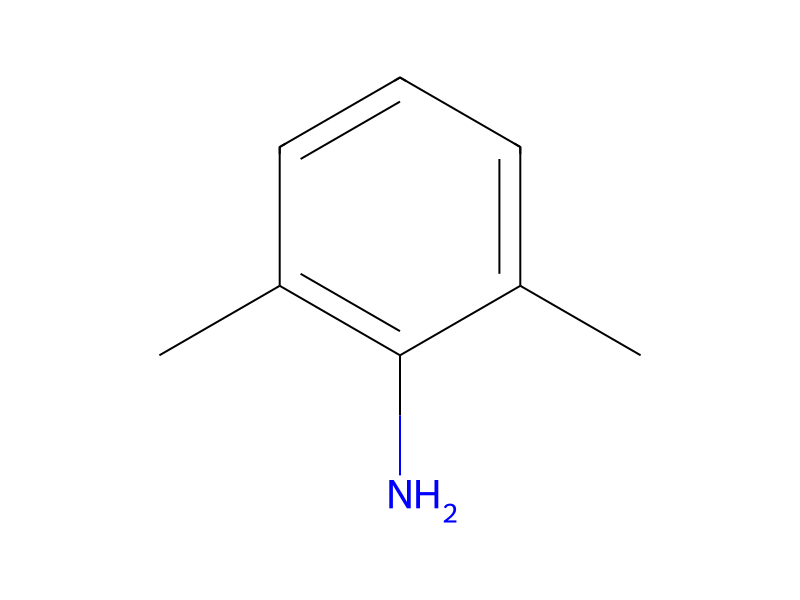
A catalyst which is in the form of extrudate of 3 mm diameter and 10 mm length and which contains 1.8% by weight of palladium on a zinc-aluminum spinel as the carrier is introduced into a reactor consisting of a pressure-resistant cylindrical tube of 1.2 liters volume, and is heated to 220° C. Per hour, a gaseous mixture of 200 liters (S.T.P.) of ammonia and 200 liters (S.T.P.) of hydrogen and 100 g of vaporized 2,6-dimethylcyclohexan-1-one are passed over this catalyst bed under atmospheric pressure. The reaction product is cooled as soon as it leaves the reactor, and is distilled. 100 g of 2,6-dimethylcyclohexan-1-one give 93 g of 2,6-dimethylaniline of boiling point 216° C. at atmospheric pressure, corresponding to a yield of 97% of theory.