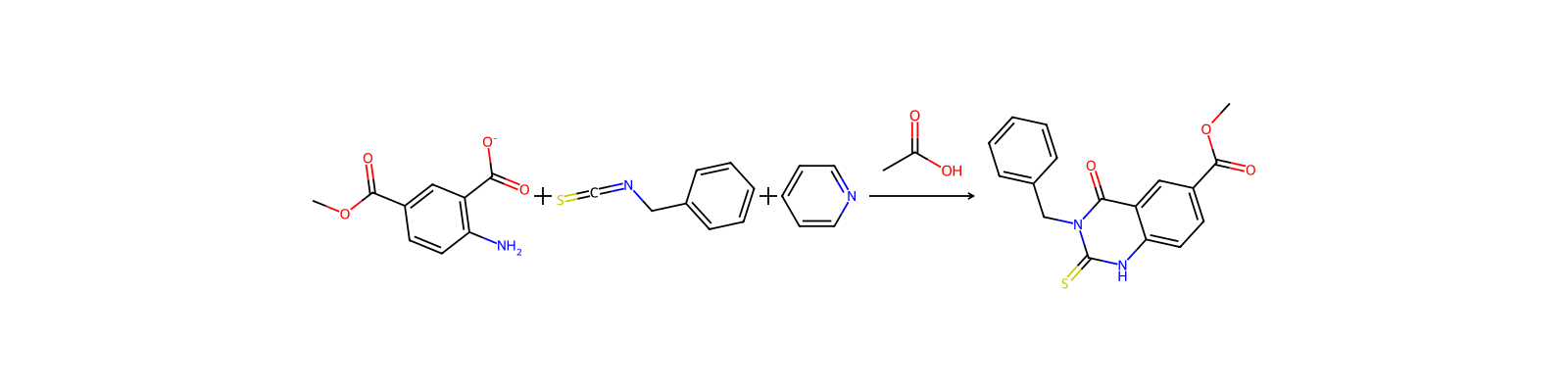
참여 물질
| 역할 | 이름 | HCID | 투입량 |
|---|
| 반응물 | Pyridine | HCID 1049 | — |
| 반응물 | Benzyl Isothiocyanate | HCID 2346 | — |
| 반응물 | 1,3-Benzenedicarboxylic acid, 4-amino-, 1-methyl ester | HCID 22591727 | — |
| 용매 | Acetic Acid | HCID 176 | — |
| 생성물 | 3-Benzyl-6-(methoxycarbonyl)-2-thioxo-1,2,3,4-tetrahydroquinazolin-4-one | HCID 22591728 | — |
반응 단계
This process is illustrated in Scheme 2 below: Methyl 4-aminoisophthalate (2a) is treated with benzyl isothiocyanate, in a solvent such as pyridine or acetic acid, to give 3-benzyl-6-(methoxycarbonyl)-2-thioxo-1,2,3,4-tetrahydroquinazolin-4-one (2b). This compound is heated, in a refluxing alcohol, in the presence of hydrazine hydrate to give the corresponding hydrazine which is in turn cyclized by reaction with a carboxylic acid derivative R1COOH (such as an acid chloride or an orthoester). The 4-benzyl-7-(methoxycarbonyl)-4,5-dihydrotriazolo[4,3-a]quinazolin-5-one (2d) obtained is N4-debenzylated using aluminium chloride in benzene, and the intermediate secondary lactam is then substituted with a halide, in the presence of a base such as cesium carbonate, in a solvent such as dimethylformamide. The N-substituted analogue obtained (2f) is then hydrolysed, preferably in acidic medium, to give the corresponding acid (2g) which may be subsequently subjected to a coupling reaction of peptide type.
출처 및 근거
| DOI | 10.6084/m9.figshare.5104873.v1 |
|---|
| 특허 번호 | US06849637B2 |
|---|
| 출처 데이터셋 | uspto-grants-2005_02 |
|---|
| ORD ID | ord-fa49c3f4e60f4f6896bc658a5dd8a849 |
|---|
| 출처 메모 | uspto-grants-2005_02 |
|---|