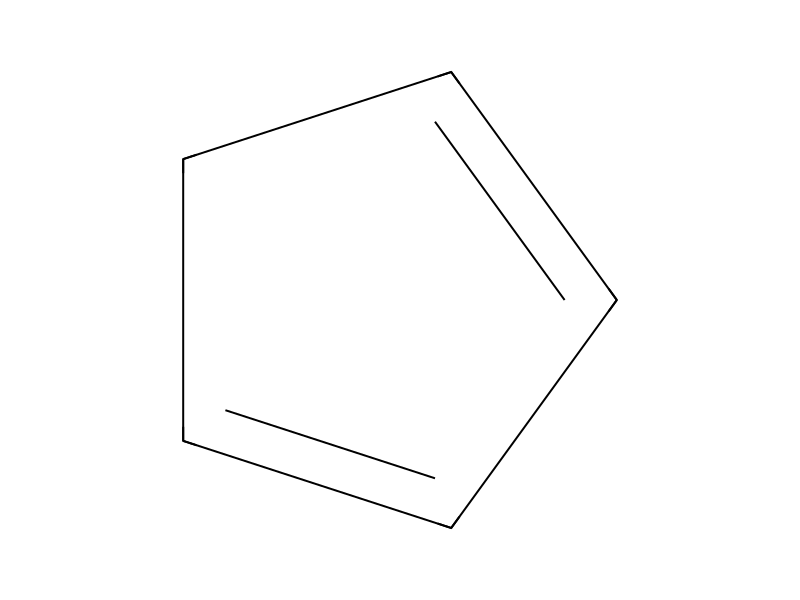
Vinylnorbornene is a Diels-Alder product of cyclopentadiene and butadiene, which boils at 141 ° C. at atmospheric pressure. Since its boiling point is too low to conduct the desired Diels-Alder cyclopentadiene additions and also to prevent loss of butadiene (i.e. via any retro Diels-Alder reaction) this oligomer was made using a Parr reactor. In a typical procedure 443 g (˜3.69 mole) of vinylnorbornene was placed in he Parr reactor, followed by 162 g (˜1.23 mole) of dicyclopentadiene. Subsequently, the reactor was sealed and the mixture was heated to 220° C. During the heating process the pressure in the reactor increased to ˜100 psi, and after several hours it dropped to about thirty psi. After four hours at temperature, the heat was turned off and the reactor was allowed to cool down to room temperature (requiring several hours). After the reactor was cool enough to open, an additional 132 g (one mole) of dicyclopentadiene was added to the Parr reactor, and the heating was resumed at 220° C. for an additional fifteen to sixteen hours. After the reaction contents were heated for the desired length of time, heating was discontinued and the vessel was allowed to cool. When the vessel had cooled sufficiently, the liquid was transferred to a round bottom flask and all of the volatiles were stripped off using a Kugelrohr ball-tube distillation apparatus, at an air bath temperature of 150° C. at full vacuum. The material remaining in the flask gelled upon cooling. Typically about 50% of the original starting material remains. Based on the 1H NMR of the collected material the end groups are deduced to be vinyl, norbornenyl, or cyclohexenyl. Based on the fact that it does not solidify, the molecules apparently have a degree of rotational freedom. The average molecular weight of this mixture was determined to be about 300 g/mole by 1H NMR integration.