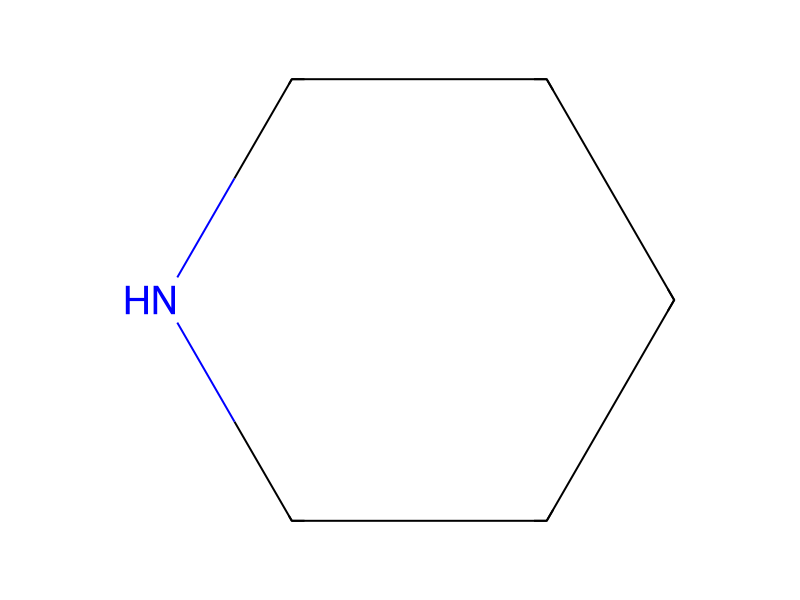
Piperidine → HCID 56931263, 화합물
HRID 239016
반응식

O[C:2]1[CH:3]=[C:4]([CH:17]=[CH:18][C:19]=1O)[CH:5]1[CH2:14][CH2:13][C:12]2[C:7](=[CH:8][C:9]([OH:16])=[CH:10][C:11]=2[OH:15])[O:6]1.[O:21]1C2C(=CC=CC=2)CCC1C1C=CC=CC=1.[NH:37]1[CH2:42][CH2:41][CH2:40][CH2:39][CH2:38]1>>[CH2:40]1[CH2:41][CH:42]([C:10]2[C:11]([OH:15])=[C:12]3[C:13]([CH:14]=[C:5]([C:4]4[CH:17]=[CH:18][CH:19]=[CH:2][CH:3]=4)[O:6][C:7]3=[CH:8][C:9]=2[OH:16])=[O:21])[NH:37][CH2:38][CH2:39]1참가 물질
4


실험 절차
The assistance of 2-D spectra, HSQC, COSY and HMBC, was required to connect the flavan skeleton and piperidine substituent in a manner reasonable to fit the data. According to the HSQC spectrum, the three protons (dd at 6.72 and 6.78 ppm and d at 6.85 ppm) correlated to the three aromatic carbons from 114 to 118 ppm. This, with the splitting pattern in the proton spectrum, indicated a 3,4-dihydroxy phenyl substituent. In keeping with the molecular formula C20H23NO5, a dihydroxy phenyl ring leaves three oxygens not yet accounted for as well as six more aromatic carbons and the structure is now comparable to 3′,4′,5,7-tetrahydroxyflavan. Due to the different chemical environment between C-6 and C-8 of the flavan and alkaloid NMR signals, a flavan structure with a nitrogen-containing substituent attached to ring A was explored. The COSY spectrum shows the saturated carbons between 20 and 30 ppm all seem to coordinate with each other but a closer look, combined with HSQC assignments, separates the three saturated carbons of the flavan from the five saturated carbons of the piperidine. The protons at 1.87 and 2.13 ppm (C-3) correlate to the protons at 2.62 ppm (C-4) as well as the proton at 5.0 ppm (C-2). Conversely, the protons of C-6″, 1.87 and 2.31 ppm, show correlations to protons at 1.62 and 1.87 ppm (C-4″ and C-5″) and the doublet at 4.54 ppm (C-1″). Additionally, C-4″ and -5″ protons correlate to C-3″ at 2.97 and 3.4 ppm. The HSQC spectrum corrected the assignment of an oxygenated methyl at 54.79 ppm to a nitrogenated methine and the downfield shift is explained by attachment to an aromatic ring. This nitrogenated methine and the nitrogenated methylene, at 46.82 ppm, can be connected to three of the five saturated 13C signals between 20 and 30 ppm (C-4″, -5″ and -6″) composing a 2-piperindinyl substituent attached to the aromatic ring A at the methine. A similar flavonoid alkaloid compound with a 2-piperidinyl substituent was used for comparison to confirm this piperidine moiety; Ahond et al. isolated N-demethylcapitavine (10). The reported 13C spectral data matches the piperidine assignments of the kinkéloids at 53.2, 46.5, 23.5, 22.6, and 27.9 ppm for C-1″-C-6″, respectively, confirming the piperidinyl moiety.