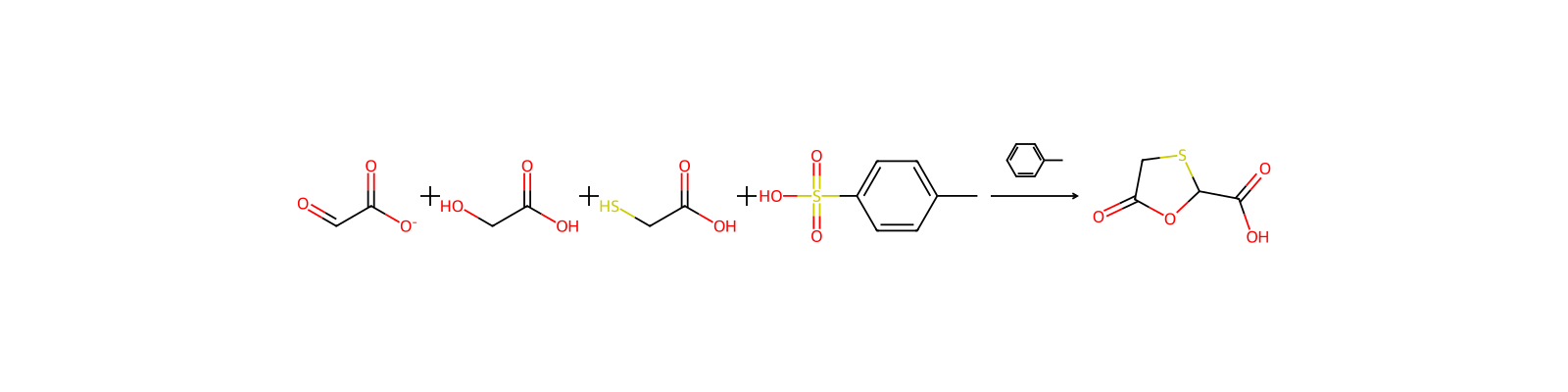
참여 물질
| 역할 | 이름 | HCID | 투입량 |
|---|
| 반응물 | Glycolic Acid | HCID 757 | — |
| 반응물 | Thioglycolic Acid | HCID 1133 | — |
| 반응물 | p-Toluenesulfonic acid | HCID 6101 | — |
| 반응물 | Npc324351 | HCID 3614358 | — |
| 용매 | Toluene | HCID 1140 | — |
| 생성물 | 5-Oxo-1,3-oxathiolane-2-carboxylic acid | HCID 15168211 | — |
반응 단계
In all cases, the 1,3-oxathiolane ring is prepared in one of the following ways: (i) reaction of an aldehyde derived from a glyoxylate or glycolic acid with mercaptoacetic acid in toluene in the presence of p-toluenesulfonic acid to give 5-oxo-1,3-oxathiolane-2-carboxylic acid (Kraus, J-L., et al., Synthesis, 1991, 1046); (ii) cyclization of anhydrous glyoxylates with 2-mercaptoacetaldehyde diethylacetal at reflux in toluene to give 5-ethoxy-1,3-oxathiolane lactone (U.S. Pat. No. 5,047,407); (iii) condensation of glyoxylic acid ester with mercaptoacetaldehyde (dimeric form) to give 5-hydroxy-1,3-oxathiolane-2-carboxylic ester or (iv) coupling of an acyloxyacetaldehyde with 2,5-dihydroxy-1,4-dithiane, the dimeric form of 2-mercaptoacetaldehyde to form a 2-(ayloxy)methyl-5-hydroxy-1,3-oxathiolane. The lactone, 5-oxo compound, has to be reduced to the corresponding lactol during the process to synthesize nucleosides. The 2-carboxylic acid or its ester also has to be reduced to the corresponding 2-hydroxymethyl derivatives with borane-methylsulfide complex.
출처 및 근거
| DOI | 10.6084/m9.figshare.5104873.v1 |
|---|
| 특허 번호 | US06855821B2 |
|---|
| 출처 데이터셋 | uspto-grants-2005_02 |
|---|
| ORD ID | ord-2b5dfc89a3fe4636b720ac9170827290 |
|---|
| 출처 메모 | uspto-grants-2005_02 |
|---|