Methyl pivaloylacetate → 11-[1,1-dimethylethyl]-9-oxo-2,3,6,7-tetrahydro-1H,5H-[1]benzopyrano[6,7,8-ij]quinolizine
HRID 257646
반응식
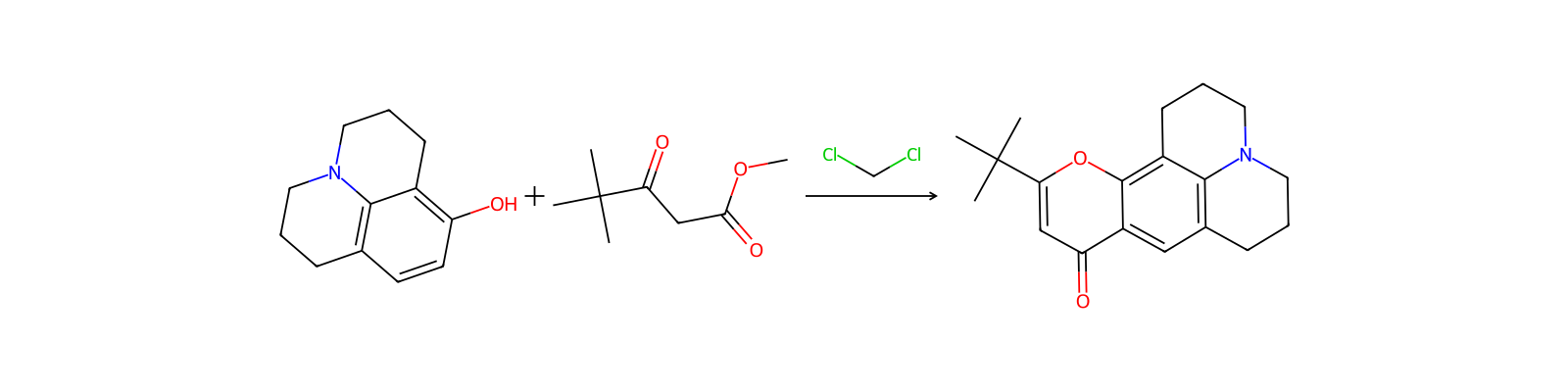
[CH2:1]1[CH2:14][N:13]2[C:4]3[C:5]([CH2:10][CH2:11][CH2:12]2)=[C:6]([OH:9])[CH:7]=[CH:8][C:3]=3[CH2:2]1.[CH3:15][C:16]([CH3:25])([CH3:24])[C:17](=O)[CH2:18][C:19](OC)=[O:20]>ClCCl>[CH3:15][C:16]([C:17]1[O:9][C:6]2[C:7](=[CH:8][C:3]3[CH2:2][CH2:1][CH2:14][N:13]4[C:4]=3[C:5]=2[CH2:10][CH2:11][CH2:12]4)[C:19](=[O:20])[CH:18]=1)([CH3:25])[CH3:24]참가 물질
4



실험 절차
8-Hydroxyjulolidine (1.0 g, 5.29 mmol) and methyl 4,4-dimethyl-3-oxopentanoate (1.0 g, 6.32 mmol) were heated together under nitrogen at 200° C. for 4 hours, after which time more methyl 4,4-dimethyl-3-oxopentanoate (0.5 g, 3.16 mmol) was added and heating was continued for 2 hours. After cooling to room temperature, the reaction mixture was dissolved in dichloromethane and applied to a short column of silica gel (approx. 200 g). Elution with dichloromethane removed non-polar by-products, while subsequent elution with ether afforded 11-[1,1-dimethylethyl]-9-oxo-2,3,6,7-tetrahydro-1H,5H-[1]benzopyrano[6,7,8-ij]quinolizine (1.12 g, 71% yield) as a brown oil which solidified on standing. The structure of this compound was confirmed by mass spectroscopy and by 1H and 13C NMR spectroscopy.