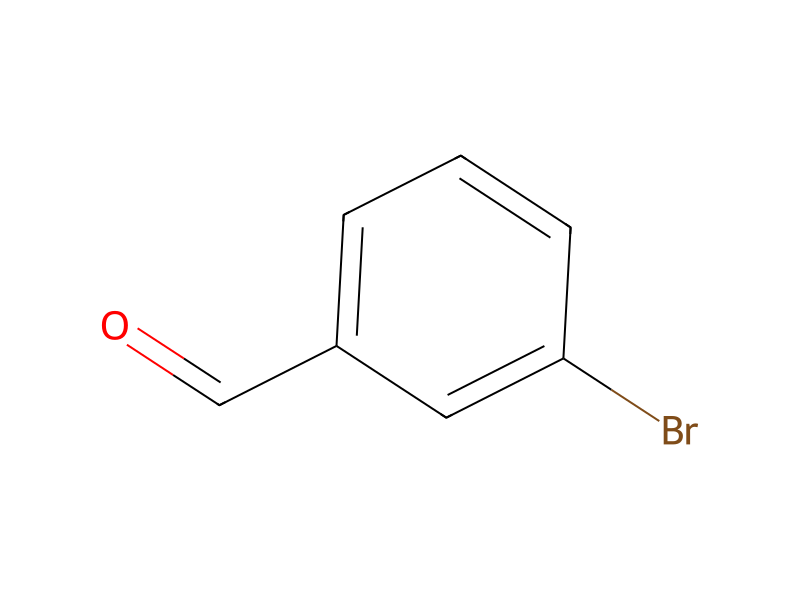
This is an example of a coupling reaction to form compounds such as the title compound by coupling compounds such as bromo benzaldehyde and 3-butyn-1-ol. A 1-L, 3-necked round-bottom flask was equipped with a magnetic stirring bar, a condenser with a nitrogen inlet, and two stoppers. The vessel was charged with 3-bromobenzaldehyde (18.5 g, 0.1 mol), 3-butyn-1-ol (10.5 g, 0.15 mol), triethylamine (100 mL), and THF (100 mL). To this mixture was then added PdCl2 (PPh3)2 (1.4 g, 2 mmol) and CuBrMe2S (0.405 g, 4 mmol). In other examples, the title compound was also obtained by using CuI together with a palladium-containing entity. The reaction mixture was heated to reflux using a heating mantle. After 4 h when TLC (thin layer chromatography) showed complete consumption of the bromide, the mixture was allowed to cool to room temperature, transferred to a 1-L round-bottom flask and concentrated under reduced pressure. The residue was dissolved in 250 mL of ethyl acetate. The solution was washed with water and brine, dried over MgSO4, and filtered. After filtration, the solvents were removed from the filtrate by evaporation under reduced pressure to obtain the title compound as pale yellow oil (16.8 g, yield 97%). Purity of the compound so obtained was determined by HPLC to be greater than 95%. TLC(Rf=0.32, SiO2, ethyl acetate/hexanes, 1:1). MS (electro spray, positive mode), M+174. 1H NMR (400 MHz, CDCl3) δ: 2.72 (t, 2H, J=6.3), 3.84 (t, 2H, J=6.2), 7.47 (t, 1 H, J=7.7), 7.66 (dt, 1 H, J=7.7, 1.4), 7.81 (dt, 1 H, J=7.7, 1.4), 7.91 (t, 1 H, J=1.4), 9.98 (s, 1H). It was found in the context of this invention, as illustrated by the embodiment given in this example, that the amount of palladium catalyst can be reduced down to catalyst amounts in the order of 0.1% (mol/mol). In contrast, conventional methodologies rely on Pd catalyst amounts in the range 1%-5%, with the percentages referred to the same units. This reduction in the amount of palladium catalyst leads to a significant cost reduction. Furthermore, this reduction in the amount of palladium catalyst leads to a reduction in the palladium contamination of the final product.