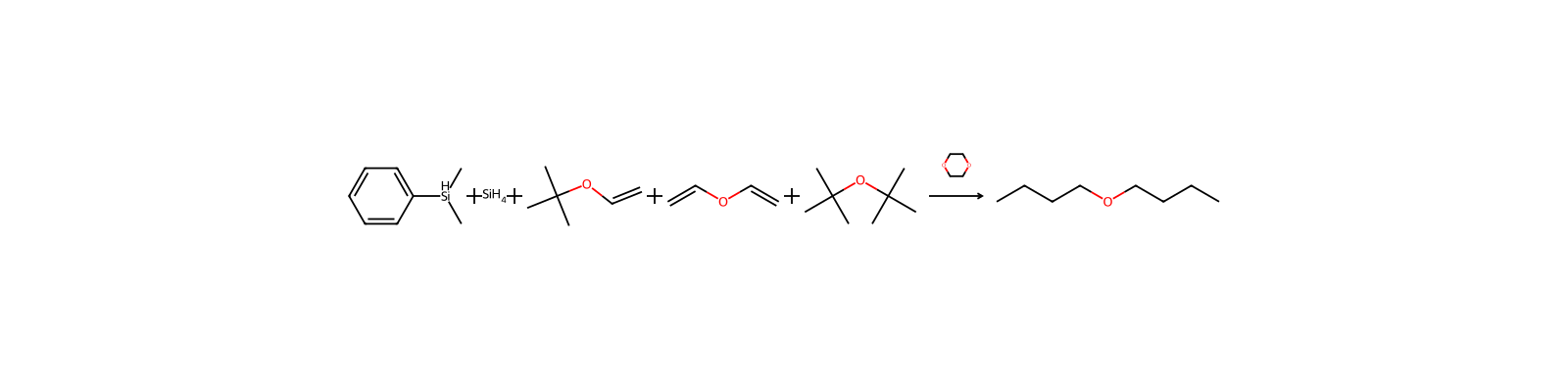
참여 물질
| 역할 | 이름 | HCID | 투입량 |
|---|
| 반응물 | Vinyl ether | HCID 8024 | — |
| 반응물 | Dimethylphenylsilane | HCID 13014 | — |
| 반응물 | Di-tert-butyl ether | HCID 22541 | — |
| 반응물 | Silane | HCID 23953 | — |
| 반응물 | Propane, 2-(ethenyloxy)-2-methyl- | HCID 70220 | — |
| 용매 | 1,4-Dioxane | HCID 31275 | — |
| 생성물 | Butyl ether | HCID 8909 | — |
반응 단계
Into a 30 ml round-bottom flask with two necks equipped with a three-way cock, in which the air had been replaced with nitrogen gas, there were added 2.15 mg (3.3×10⁻³ mmol) of acenaphthylene heptacarbonyl ruthenium (the polynuclear ruthenium-carbonyl complex as expressed by the formula (V): hereinafter sometimes referred to simply as the “Ru complex”) as the catalyst, 0.05 ml of 1,4-dioxane as the solvent, and 0.050 ml (0.33 mmol) of dimethylphenylsilane (HSiMe2Ph) as the silane compound. After stirring at room temperature (25° C.) for thirty minutes, there was added 0.43 ml (3.3 mmol) of tert-butyl vinyl ether (tBuVE) as the vinyl ether compound. The resultant solution was stirred at room temperature for ten minutes, and then the 1,4-dioxane and the excess phenyldimethyl silane were distilled off. Into the residual viscous liquid was dissolved in 2 ml of hexane. Following the addition of methanol 6 ml, the resultant white deposit was subjected to drying in vacuo, to yield a white solid material, 277 mg (92%). The molecular weight of the white solid material was determined by GPC, and the material was also subjected to the measurement of IR, 1H and 13C NMR spectra. FIG. 2 shows the GPC chart. The assignment of the IR and NMR data are summarized below. From these results the white solid material was identified to be polyvinyl tert-butyl ether.
출처 및 근거
| DOI | 10.6084/m9.figshare.5104873.v1 |
|---|
| 특허 번호 | US07425599B2 |
|---|
| 출처 데이터셋 | uspto-grants-2008_09 |
|---|
| ORD ID | ord-3bca46efe37a4c40bf5e074ba95c4320 |
|---|
| 출처 메모 | uspto-grants-2008_09 |
|---|