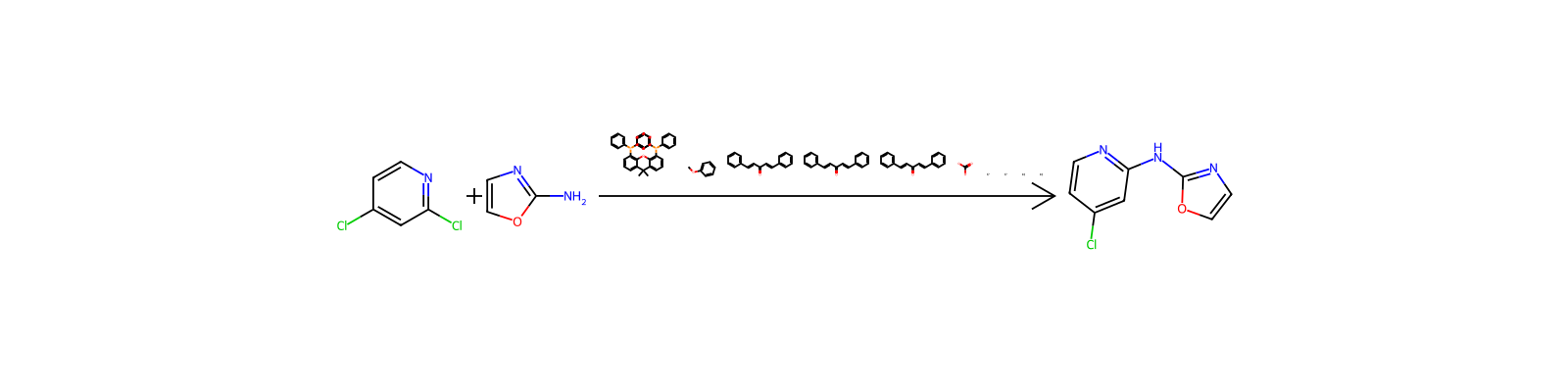
참여 물질
| 역할 | 이름 | HCID | 투입량 |
|---|
| 반응물 | 2,4-Dichloropyridine | HCID 33515 | — |
| 반응물 | 2-Aminooxazole | HCID 558521 | — |
| 시약 | Potassium Carbonate | HCID 11430 | — |
| 촉매 | 1,1'-(9,9-Dimethyl-9H-xanthene-4,5-diyl)bis(1,1-diphenylphosphine) | HCID 636044 | — |
| 촉매 | Bis(dibenzylideneacetone)palladium | HCID 9811564 | — |
| 용매 | Anisole | HCID 7519 | — |
| 생성물 | N-(4-chloro-2-pyridinyl)-1,3-oxazol-2-amine | HCID 130016260 | 49.6% |
반응 단계
Objective: Repeat of optimised conditions found in process research and devellopment screen for an isolated yield. An activated catalyst solution was prepared by adding TRIS(DIBENZYLIDENEACETONE)DIPALLADIUM(0) (61.3 mg, 0.07 mmol) and (9,9-dimethyl-9H-xanthene-4,5-diyl)bis(diphenylphosphine) (77 mg, 0.13 mmol) to an oven-dried microwave vial. The vial was then capped and purged with nitrogen and anisole (1 mL) (degassed) was added. The solution was stirred at 50°C for 40 mins, then 90°C for 15 mins (activated catalyst solution; Soln. 1). To another oven-dried microwave vial was added potassium carbonate (126 mg, 0.91 mmol), oxazol-2-amine (102 mg, 1.22 mmol) and 2,4-dichloropyridine (90 mg, 0.61 mmol) and the vial was capped and purged with nitrogen. anisole (1.35 mL) and the activated catalyst solution (0.45 mL of Soln. 1 from above) were then added (this corresponds to a catalyst loading of 10% Pd). The vessel was then heated to 120 °C for 16 h. LCMS of the crude reaction mixture indicated that the desired product was present (Rt= 1.70) along with a trace amount of the double addition product i.e. amine addition at the 2- and 4-position (Rt= 1.22 min). The reaction mixture was quenched with saturated ammonium chloride (8 mL) and transferred to a separating funnel. Ethyl acetate (15 mL) was then added and the organic layer was separated (keeping the interfacial material with the organic layer). The aqueous layer was washed with ethyl acetate (2 x 15 mL portions). The combined organics were then dried over sodium sulfate, filtered and the solvent was removed under reduced pressure. DCM (1 mL) was then added to the resulting residue (which still contained anisole (4 mL)) and this solution was loaded directly onto a silica column (40 g). The crude product was purified by flash silica chromatography, elution gradient 0 to 30% DCM (5% methanolic ammonia) in DCM, then 100% DCM (5% methanolic ammonia). Pure fractions were evaporated to dryness to afford N-(4-chloropyridin-2-yl)oxazol-2-amine (59.0 mg, 49.6 %) as an off-white solid. Note: This product was only 52% pure based on NMR strength. Conclusion: The desired product was isolated but in relatively low yield and low purity.
출처 및 근거
| 출처 데이터셋 | 750 AstraZeneca ELN dataset |
|---|
| ORD ID | ord-bc0ccb3ec3974a6197509c6aeefd5c4d |
|---|
| 출처 메모 | 750 AstraZeneca ELN dataset |
|---|