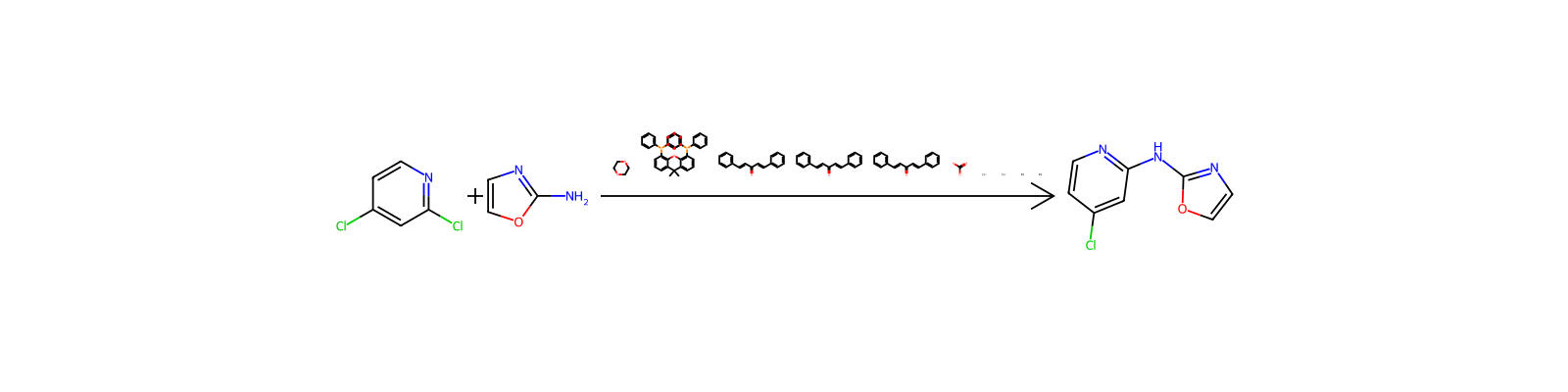
참여 물질
| 역할 | 이름 | HCID | 투입량 |
|---|
| 반응물 | 2,4-Dichloropyridine | HCID 33515 | — |
| 반응물 | 2-Aminooxazole | HCID 558521 | — |
| 시약 | Cesium carbonate | HCID 10796 | — |
| 촉매 | 1,1'-(9,9-Dimethyl-9H-xanthene-4,5-diyl)bis(1,1-diphenylphosphine) | HCID 636044 | — |
| 촉매 | Bis(dibenzylideneacetone)palladium | HCID 9811564 | — |
| 용매 | 1,4-Dioxane | HCID 31275 | — |
| 생성물 | N-(4-chloro-2-pyridinyl)-1,3-oxazol-2-amine | HCID 130016260 | 2.02% |
반응 단계
Objective: To isolate some of the required product to provide an analytical sample for a large catalyst screen. 2,4-dichloropyridine (0.109 mL, 1.01 mmol), oxazol-2-amine (85 mg, 1.01 mmol), TRIS(DIBENZYLIDENEACETONE)DIPALLADIUM(0) (22.89 mg, 0.02 mmol), (9,9-dimethyl-9H-xanthene-4,5-diyl)bis(diphenylphosphine) (44.0 mg, 0.08 mmol) (Xantphos) and cesium carbonate (660 mg, 2.03 mmol) were added to a microwave vail and the vial was purged with nitrogen. Degassed dioxane (4 mL) was then added and the reaction mixture was heated to 140 °C for 1 h under microwave irradiation. LCMS of crude reaction mixture showed some of the required product was formed, however the LCMS using acidic modifier was somewhat misleading as a side- product co-elutes with the required product thus giving the impression that a greater amount of product was formed than is the case. LCMS under acidic modifier is more informative. The crude product was purified by flash silica chromatography, elution gradient 0 to 20% heptane in EtOAc. Pure fractions were evaporated to dryness to afford N-(4-chloropyridin-2-yl)oxazol-2-amine (4.00 mg, 2.018 %) as a pale yellow residue. Conclusion: 4 mg of impure product was isolated.
출처 및 근거
| 출처 데이터셋 | 750 AstraZeneca ELN dataset |
|---|
| ORD ID | ord-bc6c718e90df4b2591cc2506c375ce3f |
|---|
| 출처 메모 | 750 AstraZeneca ELN dataset |
|---|