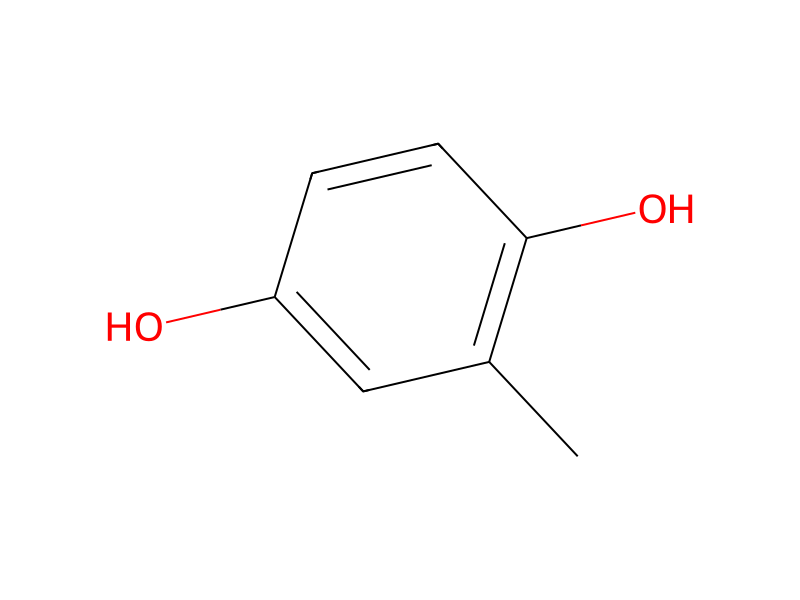
Into an autoclave (inner volume: 9 ml, made of Stainless Steel (SUS 316), equipped with amanometer) were charged 0.112 g of methylhydroquinone (manufactured by Wako Pure Chemical Ind., Ltd.), 3.372 g of methanol (extra fine reagent grade, manufactured by Wako Pure Chemical Ind., Ltd.) and 0.2 mg of sodium methylate (manufactured by Wako Pure Chemical Ind., Ltd.). The reaction was started by elevating the temperature up to 350° C. with sand bath. The pressure during the reaction was 16 MPa. After 2 hours, the autoclave was quickly cooled and the reaction solution was taken out from the autoclave when the temperature was cooled back to the room temperature. The measurement according to the process described above revealed that the conversion of methylhydroquinone was 59% by mole, the selectivity of dimethylhydroquinone was 69% by mole, the selectivity of trimethylhydroquinone was 10% by mole and no tetramethylhydroquinone was produced.