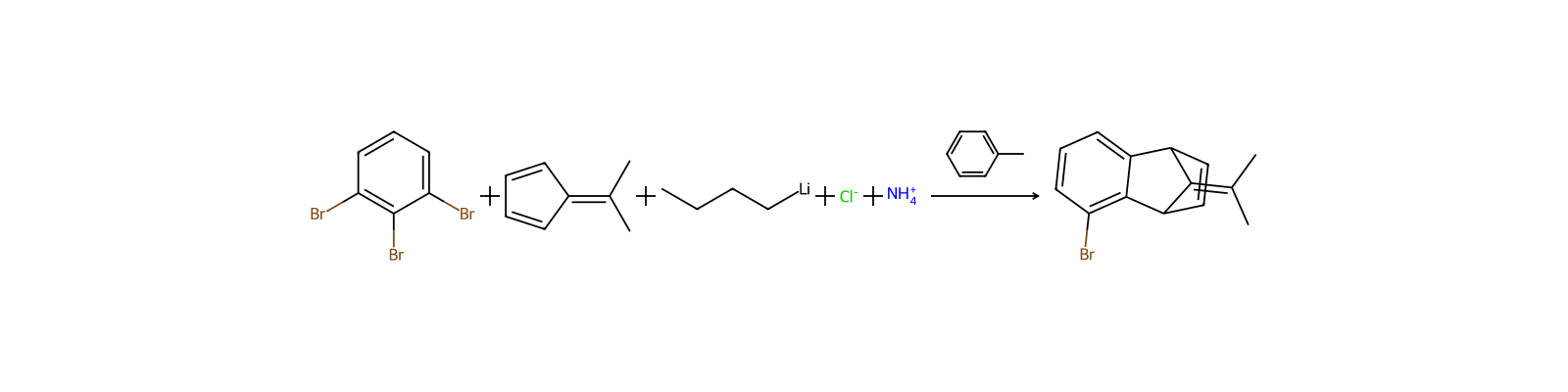
To a stirred solution of 1,2,3-tribromo-benzene (4.34 g, 13.8 mmol) and 6,6-dimethylfulvene (2.38 g, assay 92.6%, 20.7 mmol) in dry toluene (60 ml) under a nitrogen atmosphere, 5.5 ml of a 2.5M toluene solution of n-butyllithium (14.5 mmol) were added dropwise at −5 to 0° C. within 10 minutes. After a further 10 minutes at 0° C. and 2 hours at ambient temperature, the reaction mixture was poured onto a saturated aqueous solution of ammonium chloride, extracted with ethyl acetate, washed with brine and water, dried over sodium sulphate and evaporated. Purification of the crude material on silca gel in hexane afforded 2.38 g of the desired product as a yellow oil (assay 84% by g.l.c., 55% yield). This reaction is also disclosed in WO 2007/068417.