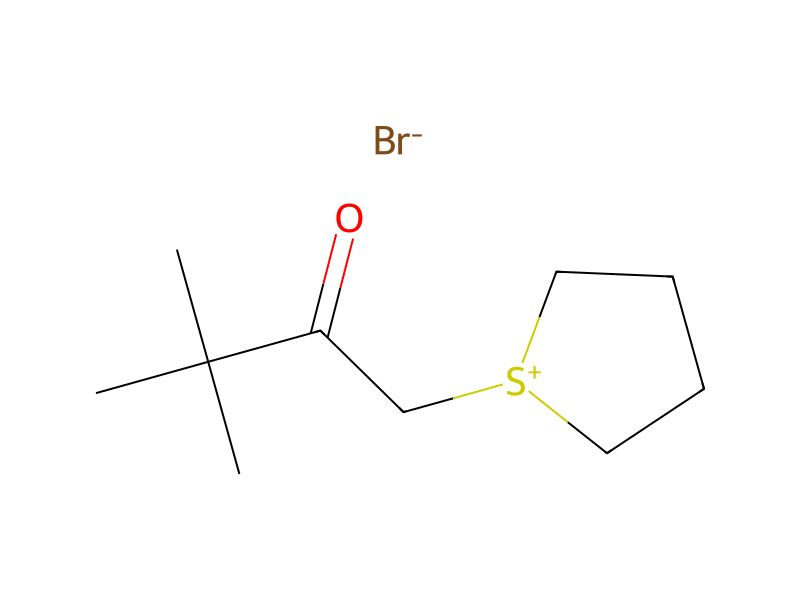
In a 300 ml three-necked flask, 2 g of 2-oxo-3,3-dimethylbutyl-thiacyclopentanium bromide obtained in Example 1 was dissolved in 20 ml of acetonitrile. To the solution, a solution prepared by dissolving 1.69 g of a potassium trifluoromethanesulfonate salt in 50 ml of acetonitrile was added dropwise. After stirring for three hours, the deposited potassium bromide was removed by filtration and acetonitrile was distilled off under reduced pressure by an evaporator. The residue was dissolved in chloroform and the insoluble matter was removed by filtration. Chloroform in the filtrate was distilled off under reduced pressure to obtain a transparent viscous liquid. To the transparent viscous liquid, 5 ml of acetone was added and the solution was added dropwise to 300 ml of diethyl ether. The deposited white crystal was collected by filtration and then recrystallized from ethyl acetate. The resulting white powder was dried under reduced pressure at 30° C. for six hours to obtain 2.21 g of 2-oxo-3,3-dimethylbutyl-thiacyclopentanium trifluoromethanesulfonate (yield: 87.7%).