반응식
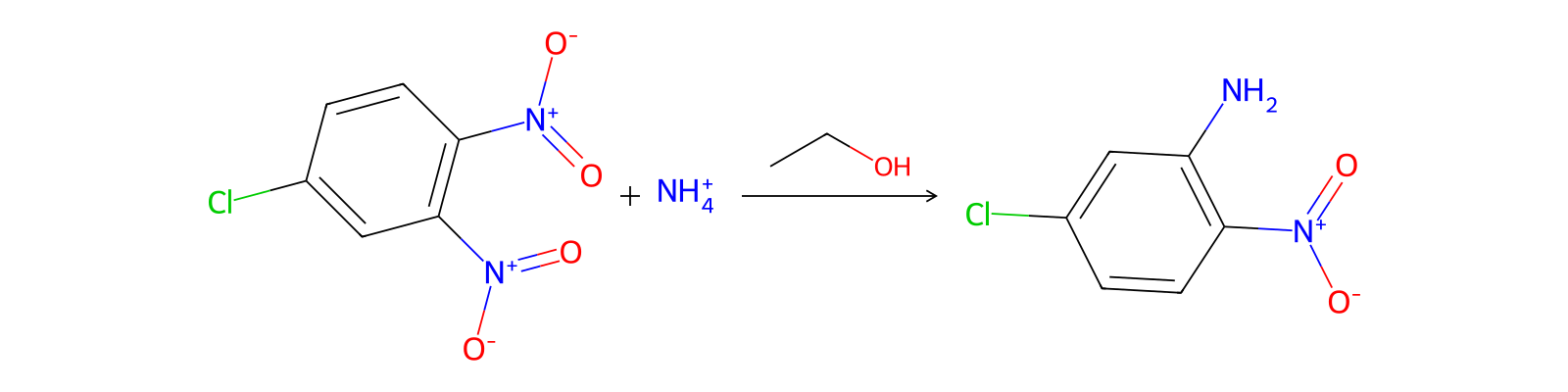
[N+:1]([C:4]1[CH:5]=[C:6]([Cl:13])[CH:7]=[CH:8][C:9]=1[N+:10]([O-:12])=[O:11])([O-])=O.[NH4+]>C(O)C>[N+:10]([C:9]1[CH:8]=[CH:7][C:6]([Cl:13])=[CH:5][C:4]=1[NH2:1])([O-:12])=[O:11]참가 물질



실험 절차
Compounds of formula I can be prepared without using the intermediate of formula II. For example, 3,4-dinitrochlorobenzene may be treated with liquid ammonium in a solvent such as ethanol to obtain 2-nitro-5-chloroaniline, which may then be treated with acetic anhydride in a solvent such as pyridine at 0°-5° C. to yield 2-nitro-5-chloroacetanilide. The 2-nitro-5-chloro acetanilide may then be converted to the corresponding 2-dialkylamino-5-chloroacetanilide by hydrogenating the nitro compound using platinum on carbon as catalyst in the presence of an aliphatic aldehyde (2:1 molar ratio to the nitro compound). The acetanilide can be hydrolyzed with a reagent such as sodium methoxide in a solvent such as methanol to give the corresponding 2-dialkylamino-5-chloroaniline. The chloroaniline can be treated with an appropriate reagent to give a 2-dialkylamino-5-substituted-aniline, e.g. the chloroaniline reacted with 1-propanethiol and sodium hydroxide in dimethylformamide/water at room temperature will yield 2-dialkylamino-5-propylthioaniline. This aniline may then be treated as the compound of formula III on page 5 to obtain a compound of formula I.
후처리
- customCompounds of formula I can be prepared
출처 및 근거
- ORD 기록
- ord-53a3ebdf15d441468909b1e846bdef45
- 출처 데이터셋
- uspto-grants-1988_02
- 특허 번호
- US04723029
연결된 노트
불러오는 중…