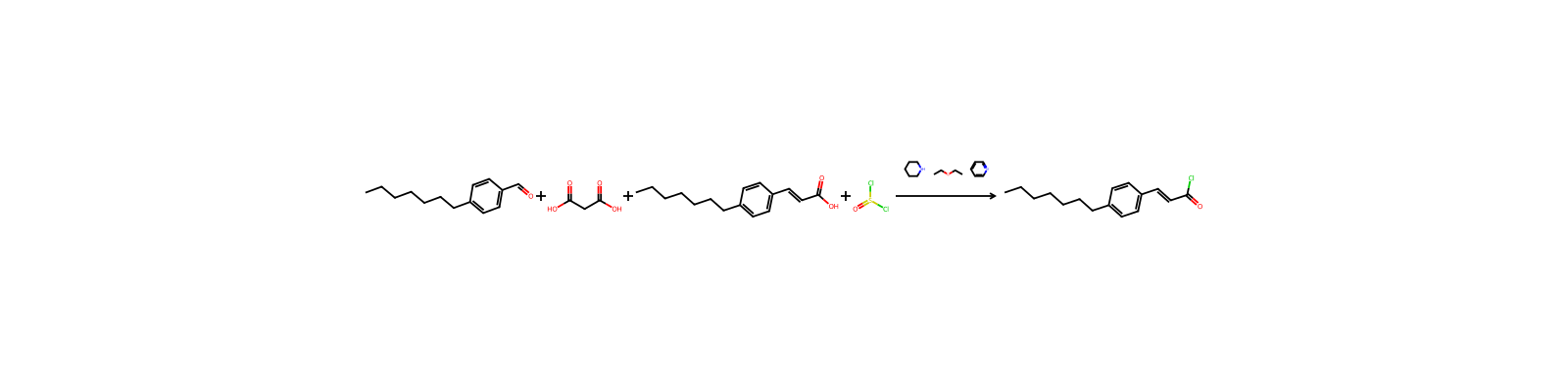
8.8 G. of p-n-heptylbenzaldehyde and 8.74 g. of malonic acid are dissolved in 7 ml. of absolute pyridine, treated with 8 drops of piperidine and heated at 90°-100° C. for 68 hours. The mixture is then taken up in ether and washed with dilute hydrochloric acid. After recrystallization from ether/hexane, there are obtained 7.5 g. of p-n-heptylcinnamic acid having a melting point of 121°-122° C. and a clearing point of 150°-153° C. 8.2 G. of this acid are boiled at reflux in 120 ml. of thionyl chloride for 30 minutes. The excess thionyl chloride is removed by distillation, the residue taken up three times in absolute toluene, concentrated and dried. The p-n-heptylcinnamic acid chloride obtained can be used in the process directly.