Dabco → 5-chloro-2,4-difluoro-N-pyrimidin-4-ylbenzenesulfonamide
반응식
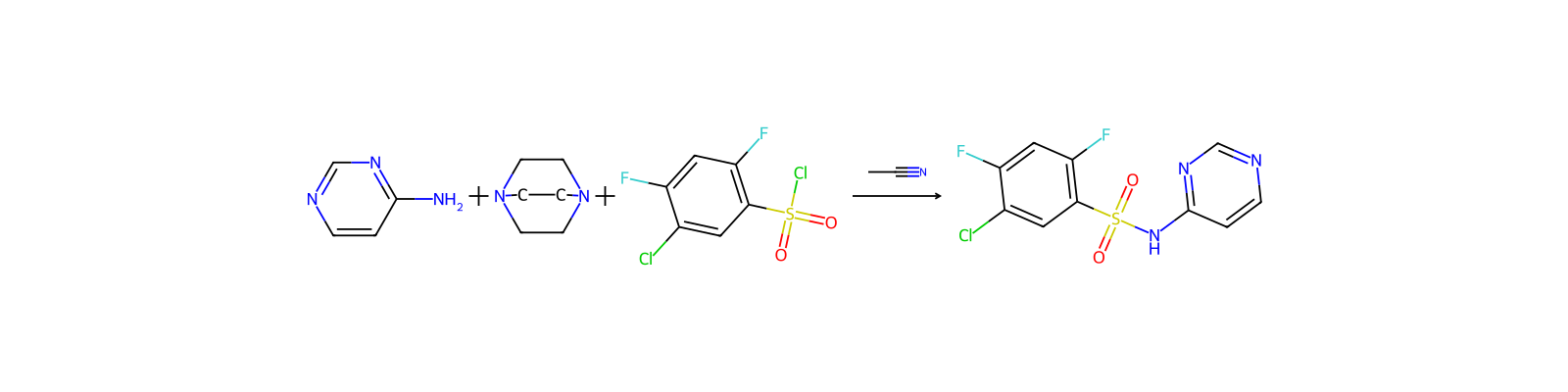
[NH2:1][C:2]1[CH:7]=[CH:6][N:5]=[CH:4][N:3]=1.N12CCN(CC1)CC2.[Cl:16][C:17]1[C:18]([F:28])=[CH:19][C:20]([F:27])=[C:21]([S:23](Cl)(=[O:25])=[O:24])[CH:22]=1>C(#N)C>[Cl:16][C:17]1[C:18]([F:28])=[CH:19][C:20]([F:27])=[C:21]([S:23]([NH:1][C:2]2[CH:7]=[CH:6][N:5]=[CH:4][N:3]=2)(=[O:25])=[O:24])[CH:22]=1참가 물질
5



실험 절차
A mixture of 4-aminopyrimidine (1.30 g, 13.7 mmol) and 1,4-diazabicyclo[2.2.2]octane (1.54 g, 13.7 mmol) were added concurrently to a solution of 5-chloro-2,4-difluorobenzenesulfonyl chloride (3.4 g, 14 mmol) in anhydrous acetonitrile (63 mL). The reaction mixture immediately turned yellow and a precipitate formed. The reaction mixture was stirred under argon. After 72 hours, the reaction mixture was filtered and the filtrate was concentrated in vacuo to give a residue. The residue was partitioned between 1M hydrochloric acid and ethyl acetate. The organic phase was separated, dried over anhydrous magnesium sulfate and concentrated in vacuo. The residue was partially purified by automated flash column chromatography using an 80 g silica gel ISCO™ column using hexanes to 1% v/v acetic acid in ethyl acetate gradient elution. The product was purified a second time by reverse phase HPLC to give the title compound (193 mg, 5%) as a white solid.