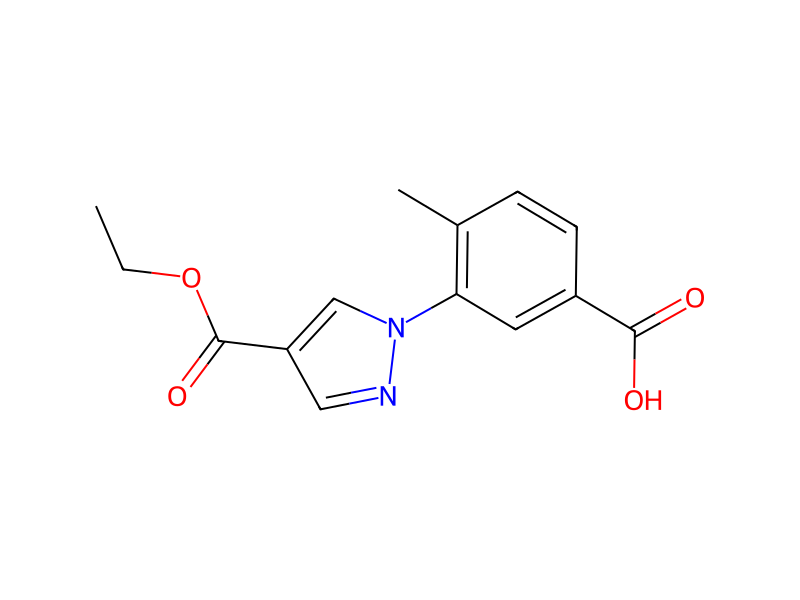
Ethyl 2-formyl-3-oxopropanoate → 1-(5-carboxy-2-methyl-phenyl)-1H-pyrazole-4-carboxylic acid ethyl ester
반응식

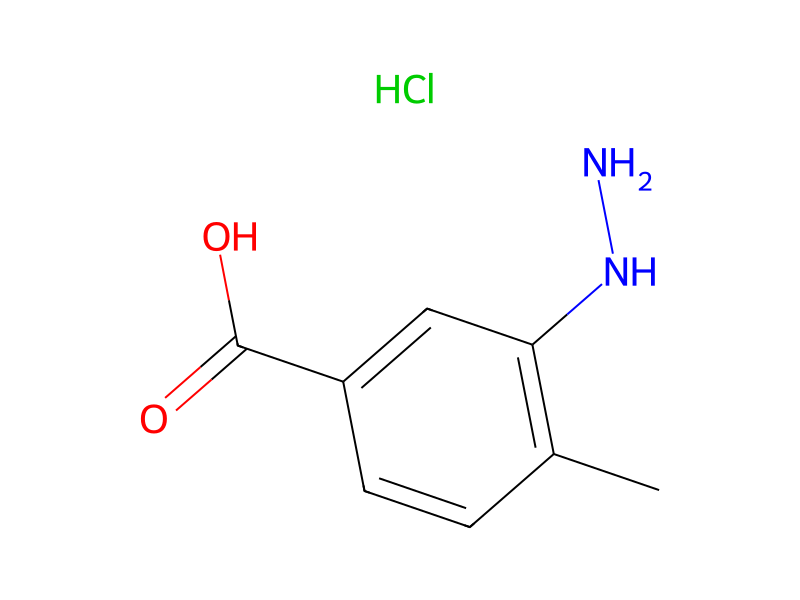
[CH2:1]([O:3][C:4](=[O:10])[CH:5]([CH:8]=O)[CH:6]=O)[CH3:2].Cl.[NH:12]([C:14]1[CH:15]=[C:16]([CH:20]=[CH:21][C:22]=1[CH3:23])[C:17]([OH:19])=[O:18])[NH2:13]>CCO>[CH2:1]([O:3][C:4]([C:5]1[CH:8]=[N:13][N:12]([C:14]2[CH:15]=[C:16]([C:17]([OH:19])=[O:18])[CH:20]=[CH:21][C:22]=2[CH3:23])[CH:6]=1)=[O:10])[CH3:2]참가 물질
4


실험 절차
A solution of 2-formyl-3-oxo-propionic acid ethyl ester (S. H. Bertz et al., J. Org. Chem., 1982, 47, 2216) (1.44 g, 10 mmol) in EtOH (10 mL) was cooled in an ice bath. A slurry of 3-hydrazino-4-methyl-benzoic acid hydrochloride (2.02 g, 10 mmol) in EtOH (50 mL) was added and the reaction was stirred overnight. The EtOH was removed under reduced pressure and the residue partitioned between water and CH2Cl2. The layers were separated and the organic layer washed with brine. The organic layer was dried over Na2SO4, filtered, and concentrated. Hexanes were added and the solution concentrated. The resulting solid was collected by vacuum filtration, washed with hexanes and dried under vacuum to provide 1-(5-carboxy-2-methyl-phenyl)-1H-pyrazole-4-carboxylic acid ethyl ester (1.86 g, 68%) as a yellow solid: ESI MS m/z 275 [C14H14N2O4+H]+.