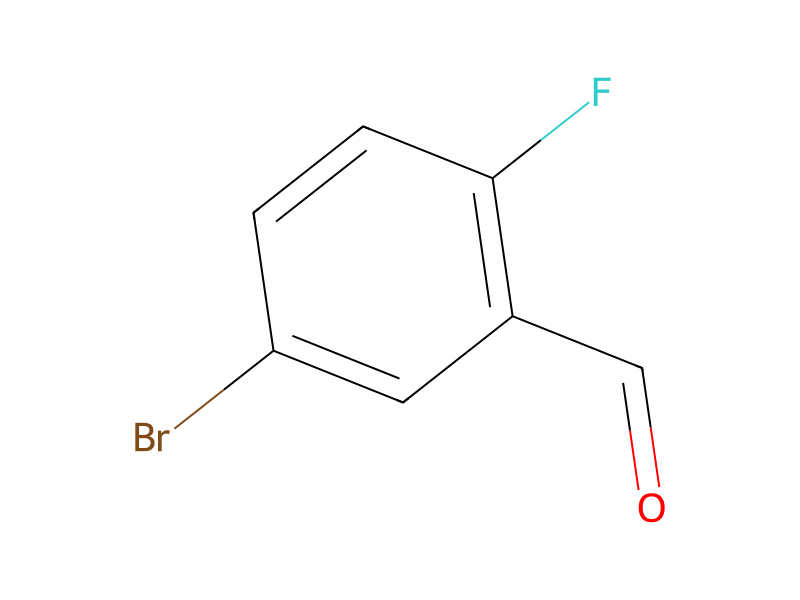
[Br:1][C:2]1[CH:3]=[CH:4][C:5](F)=[C:6]([CH:9]=1)[CH:7]=[O:8].C([O-])([O-])=O.[K+].[K+].[Cl:17][C:18]1[CH:19]=[C:20]([OH:25])[CH:21]=[CH:22][C:23]=1[Cl:24].O>CN(C=O)C>[Br:1][C:2]1[CH:3]=[CH:4][C:5]([O:25][C:20]2[CH:21]=[CH:22][C:23]([Cl:24])=[C:18]([Cl:17])[CH:19]=2)=[C:6]([CH:9]=1)[CH:7]=[O:8]To a solution of 5-bromo-2-fluoro-benzaldehyde (5.13 g, 25.4 mmol) in DMF (25 mL) were added K2CO3 (7.15 g, 51.8 mmol) and 3,4-dichloro-phenol (4.67 g, 28.8 mmol). The mixture was heated at 90° C. for 24 h and then was allowed to cool to room temperature (rt). Water was added and the mixture was extracted with Et2O. The combined organic layers were dried (MgSO4) and concentrated. The residue was diluted with DCM and hexanes and the resulting solid was collected by vacuum filtration to provide the desired product (4.74 g, 54%). 1H NMR (CDCl3): 10.36 (s, 1H), 8.06 (d, J=2.5, 1H), 7.67 (dd, J=8.8, 2.6, 1H), 7.46 (d, J=8.8, 1H), 7.17 (d, J=2.8, 1H), 6.92 (dd, J=8.8, 2.8, 1H), 6.84 (d, J=8.8, 1H).