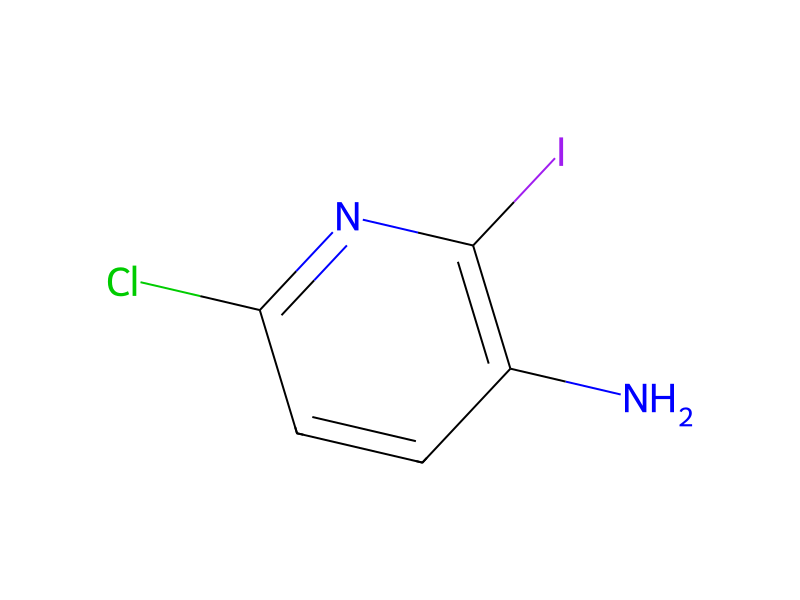
[Cl:1][C:2]1[N:7]=[C:6](I)[C:5]([NH2:9])=[CH:4][CH:3]=1.CCN(CC)CC.[CH3:17][C:18]([CH3:22])([CH3:21])[C:19]#[CH:20].N#N>C1(C)C=CC=CC=1.O.Cl[Pd](Cl)([P](C1C=CC=CC=1)(C1C=CC=CC=1)C1C=CC=CC=1)[P](C1C=CC=CC=1)(C1C=CC=CC=1)C1C=CC=CC=1.[Cu]I>[Cl:1][C:2]1[N:7]=[C:6]([C:20]#[C:19][C:18]([CH3:22])([CH3:21])[CH3:17])[C:5]([NH2:9])=[CH:4][CH:3]=1To a solution of 6-chloro-2-iodo-pyridin-3-ylamine (16.0 g, 62.7 mmol) in toluene (160 mL) and water (80 mL) were added Et3N (12.7 g, 125 mmol), Pd(PPh3)2Cl2 (2.2 g, 3.1 mmol), CuI (238 mg, 1.3 mmol) and 3,3-dimethyl-but-1-yne (7.7 g, 94 mmol) successively under N2 atmosphere. The reaction mixture was heated at 70° C. for 3 hours and was allowed to cool to room temperature. The resulting mixture was extracted with ethyl acetate (150 mL×3). The combined organic extracts were dried over anhydrous Na2SO4 and evaporated under vacuum to give 6-chloro-2-(3,3-dimethyl-but-1-ynyl)-pyridin-3-ylamine (11.5 g, 88%), which was used in the next step without further purification.