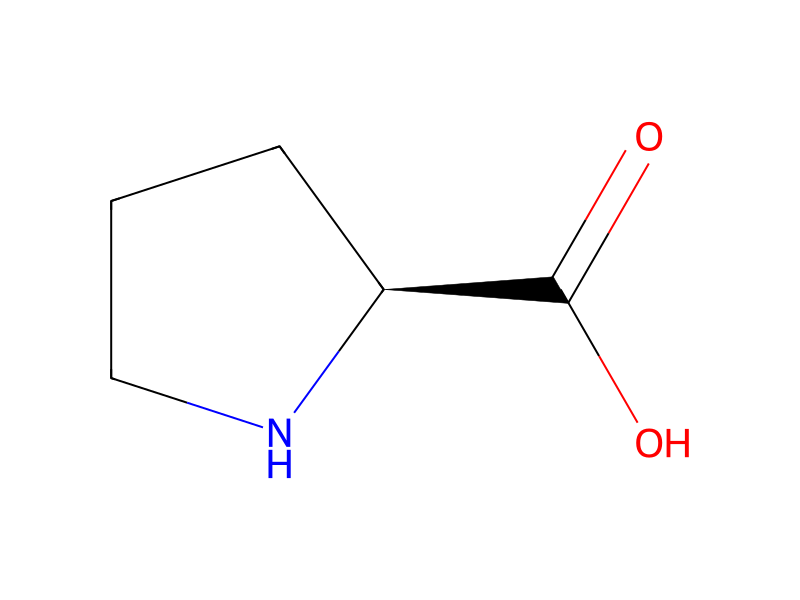
Water → HCID 12893586, 화합물
반응식

[NH:1]1[CH2:8][CH2:7][CH2:6][C@H:2]1[C:3]([OH:5])=[O:4].C(=O)([O-])O.[Na+].O.[Cl:15][C:16]1[CH:30]=[CH:29][C:19]([C:20]([S:22][CH2:23][C@H:24]([CH3:28])[C:25](Cl)=[O:26])=[O:21])=[CH:18][C:17]=1[S:31](=[O:34])(=[O:33])[NH2:32]>CO>[Cl:15][C:16]1[CH:30]=[CH:29][C:19]([C:20]([S:22][CH2:23][C@@H:24]([CH3:28])[C:25]([N:1]2[CH2:8][CH2:7][CH2:6][C@H:2]2[C:3]([OH:5])=[O:4])=[O:26])=[O:21])=[CH:18][C:17]=1[S:31](=[O:34])(=[O:33])[NH2:32]참가 물질
6





실험 절차
3 g of L-proline and 2 g of sodium hydrogen carbonate are added to 120 ml of water whereupon 3.5 g of 3-(4-chloro-3-sulfamoylbenzoylthio)-2(S)-methylpropionyl chloride is addedslowly under ice-cooling and stirring, and the resulting mixture is stirredat room temperature for 3 hours. The reaction mixture is then treated in ananalogous manner of Example 1 to give 1-[3-(4-chloro-3-sulfamoylbenzoylthio)-2(S)-methylpropionyl]-L-proline as white non-crystalline powder, [α]D25 -102.3 (methanol).