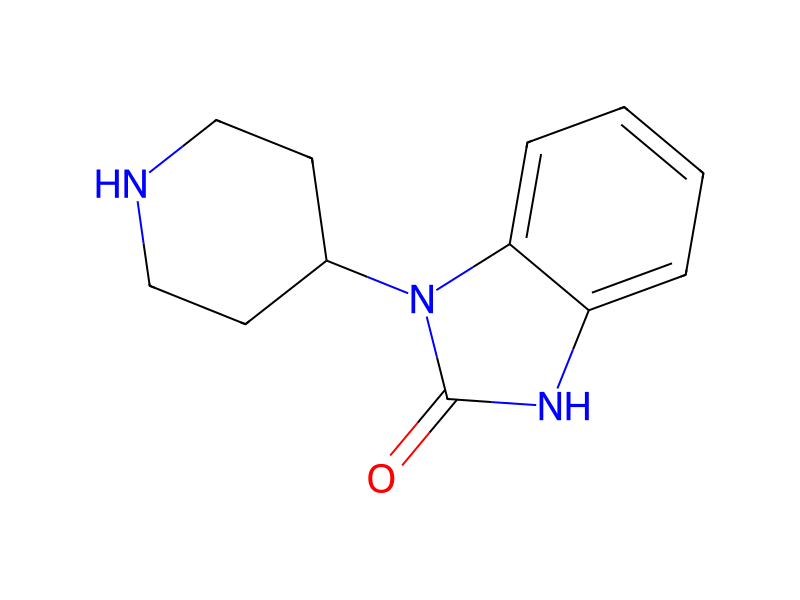
To a solution of 4-(2-keto-1-benzimidazolinyl)piperidine (0.625 g) in a mixture of dioxane (10 ml), water (2 ml), and 37% formalin (0.40 g), there were added a solution of 3-(p-fluorophenyl)-3-hydroxy-1-propyne (0.45 g) in dioxane (2 ml) and a solution of cupric sulfate pentahydrate (30 mg) in water (1 ml) under ice-cooling. The resulting mixture was heated at 80° C for 4 hours and, after cooling, the resulting mixture was filtered and the filtrate was concentrated under reduced pressure and extracted with chloroform. The chloroform extracts were dried over magnesium sulfate. After evaporation of the solvent, the residual oil was chromatographed on silica gel to afford 1-[4-(p-fluorophenyl)-4-hydroxy-2-butynyl]-4-(2-keto-1-benzimidazolinyl)piperidine as oily substance. νOHneat or νNHneat 3200 cm-1, νC=Oneat 1680 cm-1.