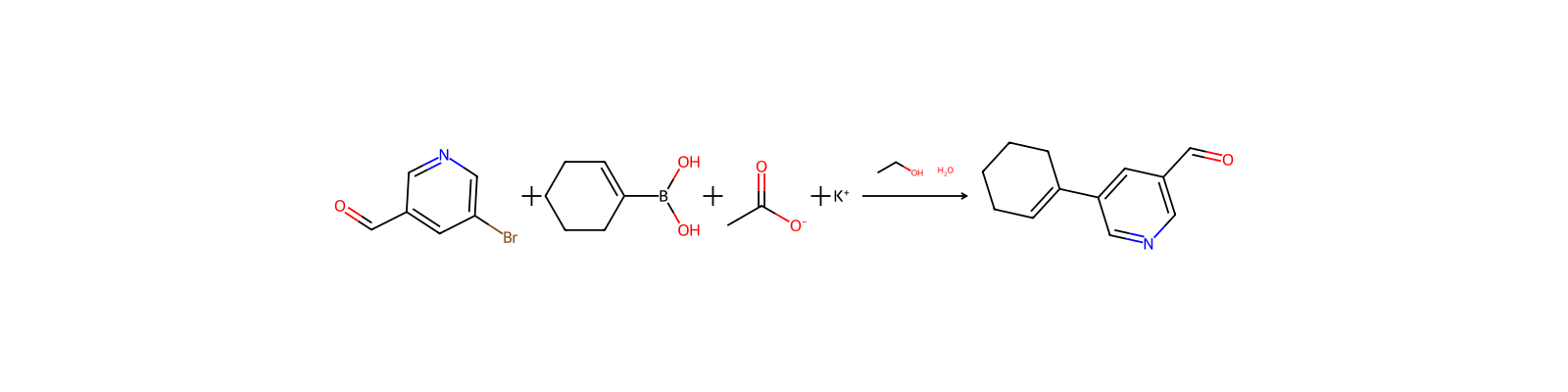
참여 물질
| 역할 | 이름 | HCID | 투입량 |
|---|
| 반응물 | Potassium Acetate | HCID 517044 | — |
| 반응물 | 5-Bromo-3-pyridinecarboxaldehyde | HCID 2784734 | — |
| 반응물 | 1-Cyclohexenylboronic acid | HCID 3862902 | — |
| 용매 | Water ethanol | HCID 19096565 | — |
| 생성물 | 5-Cyclohexenylnicotinaldehyde | HCID 86675777 | — |
반응 단계
To a suspension of 5-bromo-3-formylpyridine (1.25 g, 6.72 mmol) in EtOH/H2O (6/1, 17.8 mL) was added cyclohexenylboronic acid (1.02 g, 8.06 mmol) and potassium acetate (1.65 g, 16.8 mmol). The solution was degassed three times and dichlorobis(4-(di-tert-butylphosphino)-N,N-dimethylaniline)palladium (II) (0.084 g, 0.13 mmol) was added. The reaction was stirred at 80° C. for 18 h, and cooled to RT. The reaction mixture was concentrated, then triturated in EtOH and filtered. The filtrate was diluted with DCM and washed with water, brine, then concentrated and purified residue by column chromatography (2-25% EtOAc/hexanes). The clean fractions were concentrated to afford 5-cyclohexenylnicotinaldehyde as a tan-colored oil. Step 2: 6-Bromo-2-chloroquinoline-3-carbaldehyde (6.0 g, 22.2 mmol) was suspended in EtOH (65 mL). The solution was cooled to 0° C. and treated with sodium borohydride (1.26 g, 33.3 mmol). The reaction was warmed to RT and stirred for 40 min. The mixture was quenched with 30 mL saturated NaHCO3 solution and followed by 100 mL H2O. After gas evolution ceased, diluted with 250 mL EtOAc and washed with 2× water, 2× saturated NaHCO3 solution, and 2× brine. The organics were then dried over Na2SO4 and concentrated to afford (6-bromo-2-chloroquinolin-3-yl)methanol as a yellow solid. Step 3: (6-Bromo-2-chloroquinolin-3-yl)methanol (4.57 g, 16.8 mmol) was treated with DCM (36.4 ml, 565 mmol) and thionyl chloride (36.4 ml, 498 mmol) at ambient temperature. After 2.5 h, the reaction mixture was concentrated in vacuo and azeotroped with 3×50 mL toluene, to afford 6-bromo-2-chloro-3-(chloromethyl)quinoline as a yellow solid. Step 4: The 6-bromo-2-chloro-3-(chloromethyl)quinoline (4.9 g, 16.8 mmol) was suspended in 50 mL toluene and triphenylphosphine (4.4 g, 16.8 mmol) was added. The mixture was heated to reflux for 12 hours. Then it was allowed to cool to ambient temperature and filtered to afford ((6-bromo-2-chloroquinolin-3-yl)methyl)triphenylphosphonium chloride as a tan solid. Step 5: Treated a mixture of 5-cyclohexenylnicotinaldehyde (0.25 g) and ((6-bromo-2-chloroquinolin-3-yl)methyl)triphenylphosphonium chloride (0.73 g) with DMSO (0.36 mL) and added potassium carbonate (0.37 g). The suspension was heated to 70° C. for 1 h. The mixture was allowed to cool to ambient temperature and then partitioned between EtOAc and water. The aqueous layer was extracted with 2×EtOAc, washed the combined organics with brine and dried the organic layers over sodium sulfate. Concentrated organics in vacuo and triturated solids with MeOH (5 mL). The precipitate was collected to afford 6-bromo-2-chloro-3-(2-(5-cyclohexenylpyridin-3-yl)vinyl)quinoline as a yellow solid. Step 6: Suspended the 6-bromo-2-chloro-3-(2-(5-cyclohexenylpyridin-3-yl)vinyl)quinoline (0.35 g, 0.81 mmol) in N-methylpyrrolidone (3.1 ml, 32.4 mmol) in a vessel and added 4-methoxybenzylamine (0.32 ml, 2.4 mmol). The vessel was heated to 200° C. in microwave for 30 min. N-Methylpyrrolidone solution added slowly to rapidly stirring H2O (60 mL) and the resulting precipitate was filtered. The solid was triturated with Et2O to afford a yellow powder, N-(4-methoxybenzyl)-6-bromo-3-(2-(5-cyclohexenylpyridin-3-yl)vinyl)quinolin-2-amine. Step 7: The yellow powder, N-(4-methoxybenzyl)-6-bromo-3-(2-(5-cyclohexenylpyridin-3-yl)vinyl)quinolin-2-amine, was dissolved in TFA (1.5 ml, 19.5 mmol) and heated to 90° C. for 1 h. Removed volatiles in vacuo and then treated residue with 3 mL MeOH. Resulting suspension was loaded directly onto an SCX column and eluted with MeOH followed by 2M NH3 in MeOH. Basic fraction was concentrated to afford 6-bromo-3-(2-(5-cyclohexenylpyridin-3-yl)vinyl)quinolin-2-amine. Step 8: To a suspension of 6-bromo-3-(2-(5-cyclohexenylpyridin-3-yl)vinyl)quinolin-2-amine (0.10 g, 0.25 mmol) in EtOH/H2O (6/1, 0.5 mL) was added o-tolylboronic acid (0.042 g, 0.31 mmol) and potassium acetate (0.060 g, 0.62 mmol). The solution was degassed three times and then dichlorobis(4-(di-tert-butylphosphino)-N,N-dimethylaniline)palladium (II) (0.0035 g, 0.0049 mmol) was added. The reaction was heated to 100° C. for 2 h, then cooled to RT. Mixture was diluted with 15 mL H2O and filtered. The precipitate was washed with water then diethyl ether and air-dried to afford a bright yellow solid: 3-(2-(5-cyclohexenylpyridin-3-yl)vinyl)-6-o-tolylquinolin-2-amine.
출처 및 근거
| DOI | 10.6084/m9.figshare.5104873.v1 |
|---|
| 특허 번호 | US08822485B2 |
|---|
| 출처 데이터셋 | uspto-grants-2014_09 |
|---|
| ORD ID | ord-a40677ff1111457b9311f7577bf3be27 |
|---|
| 출처 메모 | uspto-grants-2014_09 |
|---|