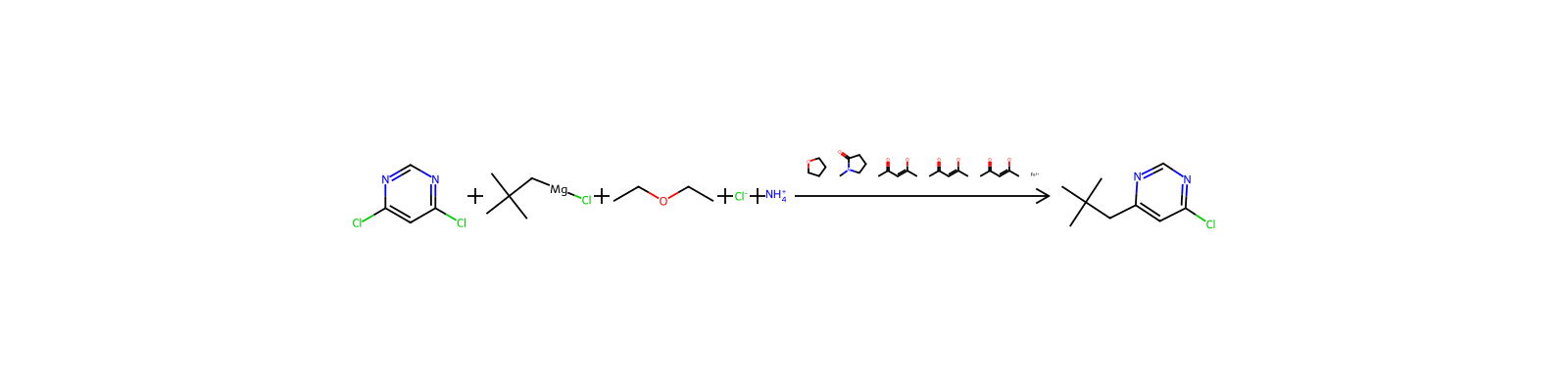
(Acetylacetonato) iron(III) (0.18 g, 0.52 mmol) and 4,6-dichloropyrimidine (1.55 g, 10.4 mmol) were dissolved in a mixture of THF (10 mL) and N-methylpyrrolidinone (1 mL) and placed in an ice bath. 2,2-Dimethylpropylmagnesium chloride, 1.0M solution in diethyl ether (11.44 mL, 11.44 mmol) was added slowly over 5 min. After 15 min saturated ammonium chloride was added to quench and the mixture was extracted with EtOAc (100 mL). The organic was washed with water (2×100 mL) then dried with magnesium sulfate and evaporated to dryness under reduced pressure. Purification using silica chromatography (hexane to dichloromethane gradient) gave 4-chloro-6-neopentylpyrimidine. Step 2: 4-Chloro-6-neopentylpyrimidine (1.5 g, 8.0 mmol), tributyl(1-ethoxyvinyl)tin (2.7 ml, 8.0 mmol) and bis(4-(di-tert-butylphosphino)-N,N-dimethylaniline)dichloropalladium (II) (0.28 g, 0.40 mmol) were dissolved in dry DMF (20 mL) and heated to 80° C. The mixture was stirred for 24 h then water (200 mL) and EtOAc (200 mL) were added and the phases mixed and separated. The organic layer was dried with magnesium sulfate and evaporated to dryness under reduced pressure. The crude was diluted with hexane (100 mL) and methanol (100 mL) and the phases mixed and separated. The hexane fraction was discarded and the methanol fraction evaporated to dryness under reduced pressure. Purification using column chromatography (hexane to ethyl acetate gradient) gave 4-(1-ethoxyvinyl)-6-neopentylpyrimidine (1.1 g). The material was dissolved in a mixture of tetrahydrofuran (30 mL) and 5 N HCl (10 mL) and stirred for 1 h. Ethyl acetate (200 mL) and water (200 mL) were added, and the phases were mixed and separated and the organic dried with magnesium sulfate before evaporating to dryness under reduced pressure. The crude 1-(6-neopentylpyrimidin-4-yl)ethanone (0.87 g) was used directly without purification. Step 3: 1-(6-neopentylpyrimidin-4-yl)ethanone (0.87 g, 4.5 mmol) and ((6-bromo-2-chloroquinolin-3-yl)methyl)triphenylphosphonium chloride (2.5 g, 4.5 mmol; prepared as in Example 2, Step 4) were dissolved in dry THF (80 mL) and treated with 1,1,3,3-tetramethylguanidine (0.74 ml, 5.9 mmol). The reaction was heated to 60° C. for 2.5 h and then evaporated to dryness under reduced pressure and purified by column chromatography (hexane to ethyl acetate gradient). The alkene was dissolved in N-methylpyrrolidinone (1 mL) and treated with excess 4-methoxybenzylamine (0.15 ml, 1.1 mmol) then heated in the microwave to 150° C. for 30 min. The reaction solution was partioned between water (100 mL) and ethyl acetate (50 mL). The organic was dried with magnesium sulfate and evaporated to dryness under reduced pressure. Purification with column chromatography (hexane to ethyl acetate gradient) gave the desired (E)-N-(4-methoxybenzyl)-6-bromo-3-(2-(6-neopentylpyrimidin-4-yl)prop-1-enyl)quinolin-2-amine. Step 4: (E)-N-(4-methoxybenzyl)-6-bromo-3-(2-(6-neopentylpyrimidin-4-yl)prop-1-enyl)quinolin-2-amine (0.025 g, 0.046 mmol), potassium acetate (0.0029 ml, 0.046 mmol), o-tolylboronic acid (0.0075 g, 0.055 mmol) and the palladium catalyst (0.033 g, 0.046 mmol) were suspended in ethanol (30 mL) and water (5 mL) and heated to 70° C. After 2 h the solution was evaporated to dryness under reduced pressure and partioned between ethyl acetate (100 mL) and water (100 mL). The organic was dried with magnesium sulfate and evaporated to dryness under reduced pressure. The crude was dissolved in DCM (20 mL) and methanol (20 mL) and treated with palladium on carbon (10% by wt, 0.23 g). The mixture was hydrogenated under 60 psi overnight, then filtered through a pad of celite and evaporated to dryness under reduced pressure. The crude material was dissolved in TFA (30 mL) and heated to 70° C. for 1 h. The reaction mixture was evaporated to dryness under reduced pressure. The crude was free based using dichloromethane and saturated sodium bicarbonate then purified by column chromatography (0-10% methanol in DCM gradient) to give 3-(2-(6-neopentylpyrimidin-4-yl)propyl)-6-o-tolylquinolin-2-amine. (ESI, pos. ion) m/z: 425 (M+1).