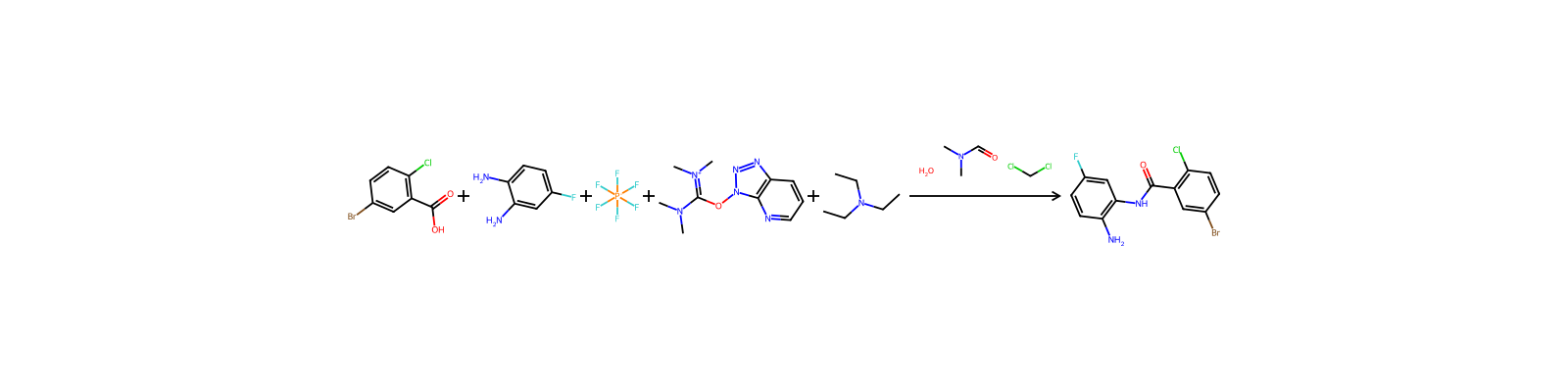
[Br:1][C:2]1[CH:3]=[CH:4][C:5]([Cl:11])=[C:6]([CH:10]=1)[C:7]([OH:9])=O.[F:12][C:13]1[CH:14]=[C:15]([NH2:20])[C:16]([NH2:19])=[CH:17][CH:18]=1.F[P-](F)(F)(F)(F)F.N1(OC(N(C)C)=[N+](C)C)C2N=CC=CC=2N=N1.C(N(CC)CC)C>O.CN(C)C=O.ClCCl>[NH2:19][C:16]1[CH:17]=[CH:18][C:13]([F:12])=[CH:14][C:15]=1[NH:20][C:7](=[O:9])[C:6]1[CH:10]=[C:2]([Br:1])[CH:3]=[CH:4][C:5]=1[Cl:11]Method 3,4—Step a To a mixture of the solids 5-Bromo-2-chlorobenzoic acid (7.00 g, 29.79 mmol), 4-Fluoro-benzene-1,2-diamine (4.65 g, 36.94 mmol) and O-(7-Azabenzotriazol-1-yl)-N,N,N′,N′-tetramethyluronium hexafluorophosphate (HATU) (11.89 g, 31.28 mmol), triethylamine (TEA) (4.60 mL, 32.77 mmol), dichloromethane (120 mL) and dimethylformamide (DMF) (30 mL) were added. The reaction mixture was stirred at room temperature overnight, water was added (30 mL) and stirred until the formation of a precipitate. The precipitate was filtered off, washed with dichloromethane (3×10 mL) and dried to afford 6.90 g of the title compound (69%).
불러오는 중…