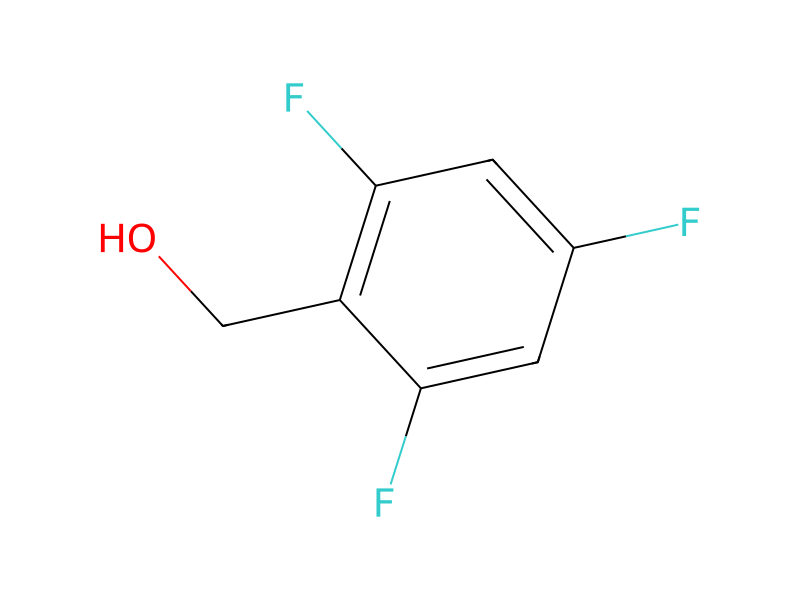
[F:1][C:2]1[CH:7]=[C:6]([F:8])[CH:5]=[C:4]([F:9])[C:3]=1[CH2:10][OH:11].N1C=CC=CC=1.[Cl:18][C:19]([C:29]([F:32])([F:31])[F:30])=[CH:20][C@@H:21]1[C@H:23]([C:24](Cl)=[O:25])[C:22]1([CH3:28])[CH3:27].C(Cl)(Cl)=O>C1(C)C=CC=CC=1>[Cl:18][C:19]([C:29]([F:30])([F:31])[F:32])=[CH:20][C@@H:21]1[C@H:23]([C:24]([O:11][CH2:10][C:3]2[C:2]([F:1])=[CH:7][C:6]([F:8])=[CH:5][C:4]=2[F:9])=[O:25])[C:22]1([CH3:28])[CH3:27]A stirred solution of 1.5 grams (0.009 mole) of 2,4,6-trifluorophenylmethyl alcohol and 0.8 gram (0.01 mole) of pyridine in 30 ml of toluene was warmed to 50° and 2.4 grams (0.009 mole) of cis-3-(2-chloro-3,3,3-trifluoro-1-propenyl)-2,2-dimethylcyclopropanecarbonyl chloride was added. The addition caused a solid precipitate to form in the reaction mixture. Upon completion of the addition of the carbonyl chloride, the reaction mixture was heated under reflux for two hours, then allowed to cool to ambient temperature as it was stirred for 16 hours. The reaction mixture was placed on a column of 100 grams of silica gel and eluted with toluene. The appropriate fractions were combined and concentrated under reduced pressure to a clear residual oil. The residual oil was distilled under reduced pressure using a Kugelrohr distilling system. The appropriate fractions were combined to give 0.4 gram of 2,4,6-trifluorophenylmethyl cis-3-(2-chloro-3,3,3-trifluoro-1-propenyl)-2,2-dimethylcyclopropanecarboxylate as an oil; nD25 1.4681.
불러오는 중…