Dimethyl alpha-ketoglutarate → Methyl 3-(7-bromo-3-oxo-3,4-dihydroquinoxalin-2-yl)propanoate
HRID 930241
반응식

[Br:1][C:2]1[CH:3]=[C:4]([NH2:9])[C:5]([NH2:8])=[CH:6][CH:7]=1.O=[C:11]([CH2:16][CH2:17][C:18](OC)=[O:19])[C:12]([O:14][CH3:15])=[O:13]>CO>[Br:1][C:2]1[CH:3]=[C:4]2[C:5]([NH:8][C:18](=[O:19])[C:17]([CH2:16][CH2:11][C:12]([O:14][CH3:15])=[O:13])=[N:9]2)=[CH:6][CH:7]=1참가 물질
4

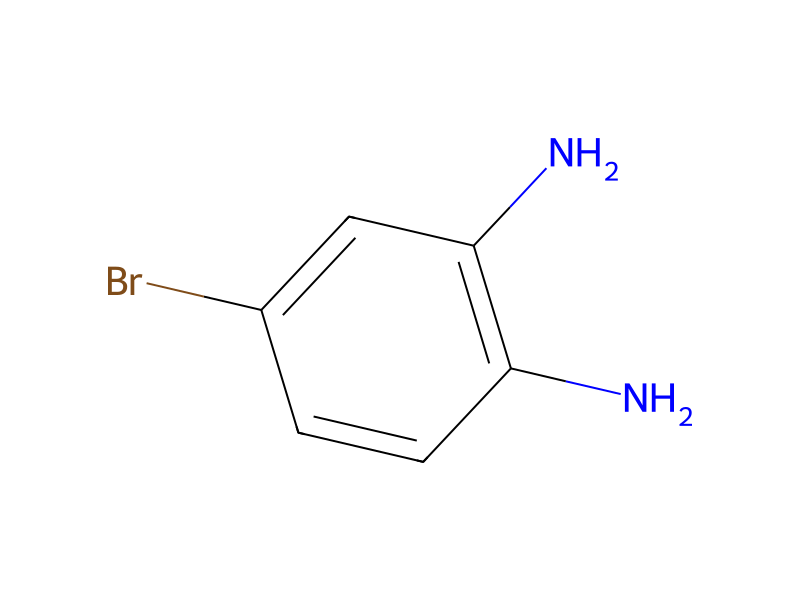


반응 조건
- 온도
- 140 °C
실험 절차
To a 25 ml microwave synthesizer vial containing 4-bromobenzene-1,2-diamine (2.30 g, 12.3 mmol) in 15 ml of MeOH was added dimethyl 2-oxopentanedioate (2.14 g, 12.3 mmol). The mixture was heated in the microwave synthesizer at 140° C. for 12 min. Red precipitate formed, which was filtered, and washed successively with 10 ml of MeOH (1×), 10 ml of DCM (1×), and 15 ml of hexanes (2×) to give methyl 3-(7-bromo-3-oxo-3,4-dihydroquinoxalin-2-yl)propanoate as a light purple solid after drying. M+H+: 312. Step 2 Methyl 3-(7-bromo-3-chloroquinoxalin-2-yl)propanoate from Step 1 (0.65 g, 1 mmol) was treated with phosphoryl trichloride (4 ml, 44 mmol) at about 102° C. for 1.5 h. An initial suspension became a black solution. The solution was cooled and pipetted over to 50 g of crushed ice. After the ice melted, 35 ml of DCM was added, and the reaction mixture was vigorously mixed and then the layers were separated. The DCM layer was dried (Na2SO4) and concentrated to give methyl 3-(7-bromo-3-chloroquinoxalin-2-yl)propanoate as an oil. M+H+: 329, 331. Step 3 A solution of N-ethyl-N-isopropylpropan-2-amine (523 μl, 3004 μmol), (4-methoxyphenyl)methanamine (302 mg, 2203 μmol) and 3-(7-bromo-3-chloroquinoxalin-2-yl)propanoate (660 mg) in 10 ml of DMF was stirred at rt for 48 h. TLC showed incomplete reaction (˜60% conversion). (4-Methoxyphenyl)methanamine (302 mg, 2203 μmol) was added and the solution was transferred to a microwave vial and heated at 100° C. for 10 min. The reaction was diluted with EtOAc 30 ml, washed with 30 ml of H2O, and the aqueous layer was extracted with 20 ml of EtOAc. The organic layers were combined, washed with again with 2×30 ml of H2O, dried (Na2SO4), and concentrated to give methyl 3-(7-bromo-3-(4-methoxybenzylamino)quinoxalin-2-yl)propanoate as an oil that was moved onto the next step without any further purification. M+H+: 430, 432. Step 4 3-(7-Bromo-3-(4-methoxybenzylamino)quinoxalin-2-yl)propanoate from was dissolved in 5 ml of THF and 5 mL of MeOH. 10 ml of 1N NaOH solution was added and the resulting mixture was heated in a microwave synthesizer for 15 min at 110° C. Organic solvents were removed and the aqeuous solution was then treated with 30 ml of NaH2PO4 solution (10%) and extracted with 3×30 ml of DCM. The organic layers were combined, then dried (Na2SO4) and concentrated to give 3-(7-bromo-3-(4-methoxybenzylamino)quinoxalin-2-yl)propanoic acid (36) a brown solid. Step 5 A solution of 3-(7-bromo-3-(4-methoxybenzylamino)quinoxalin-2-yl)propanoic acid (730 mg, 877 μmol), N-ethyl-N-isopropylpropan-2-amine (458 μl, 2631 μmol) and cyclohexylmethanamine (208 mg, 1841 μmol) in 10 ml of DCM was treated with HATU (733 mg, 1929 μmol) at rt for 30 min. The reaction was diluted with 30 ml of DCM, washed with 2×30 ml of H2O, 1×30 ml of 1N NaOH, dried (Na2SO4) and concentrated to give a residue which was purified by ISCO using 0-30% EtOAc in hexanes. Desired fractions were concentrated to give 3-(7-bromo-3-(4-methoxybenzylamino)quinoxalin-2-yl)-N-(cyclohexylmethyl)propanamide 37. M+H+: 511, 513. Step 6 To a microwave vial containing potassium acetate (154 mg, 1564 μmol), o-tolylboronic acid (133 mg, 978 μmol), and 3-(7-bromo-3-(4-methoxybenzylamino)quinoxalin-2-yl)-N-(cyclohexylmethyl)propanamide from Step 5 (400 mg, 391 μmol) in 3 ml of EtOH and 1 ml of H2O was added PdCl2(AmPhos)2 (8.31 mg, 11.7 μmol) and the mixture was heated at 120° C. for 15 min. The mixture was then concentrated and diluted with 20 ml of EtOAc and washed with sat. NaHCO3 (2×20 ml). The organic layer was then dried (Na2SO4) and concentrated to give compound 38 as an oil. M+H+: 523. Step 7 The crude 3-(7-bromo-3-(4-methoxybenzylamino)quinoxalin-2-yl)-N-(cyclohexylmethyl)propanamide was dissolved in 3 ml of TFA and was transferred to a microwave vial and heated at 100° C. for 10 min. The excess TFA was removed under vacuum. The residue was partitioned between DCM and 1N NaOH. The DCM layer was separated and concentrated to give an oil, which was taken into a DMF solution (5 mL) and was purified by HPLC. The desired fractions were combined and basicified with 1N NaOH, extracted with 3×40 ml of DCM. The combined DCM layers were dried (Na2SO4) and concentrated. The residue was then further purified by prep TLC using 4% MeOH in DCM. The desired bands were eluted with 4% MeOH in DCM and vacuum dried to give 3-(3-amino-7-o-tolylquinoxalin-2-yl)-N-(cyclohexylmethyl)propanamide 39 as a white solid. M+H+: 403.