Piperazine → 1-(4-Fluoro-benzyl)-6-methyl-2-oxo-4-(piperazin-1-yl)-1,2-dihydro-quinolin-3-carbonitrile
반응식
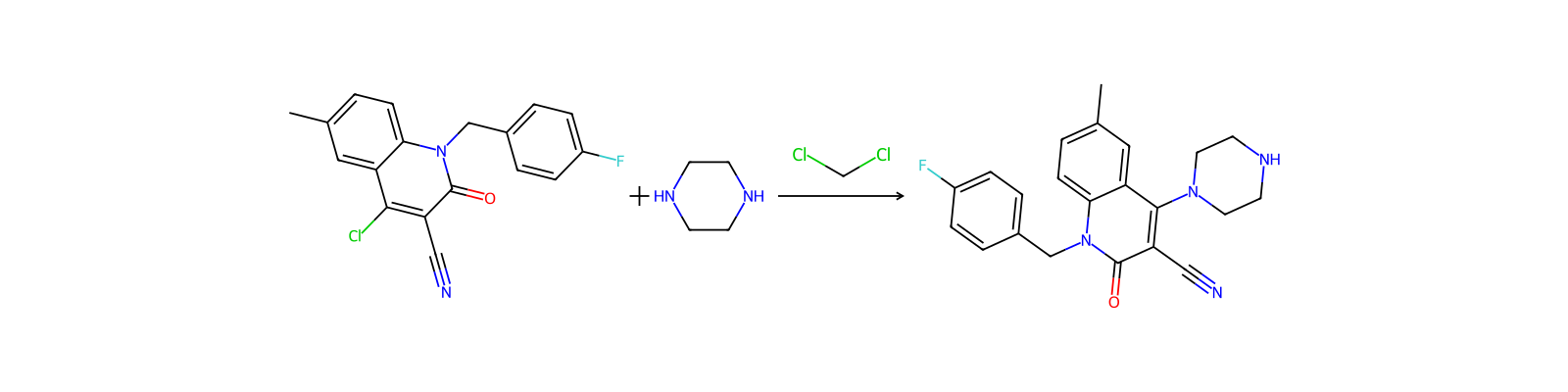
Cl[C:2]1[C:11]2[C:6](=[CH:7][CH:8]=[C:9]([CH3:12])[CH:10]=2)[N:5]([CH2:13][C:14]2[CH:19]=[CH:18][C:17]([F:20])=[CH:16][CH:15]=2)[C:4](=[O:21])[C:3]=1[C:22]#[N:23].[NH:24]1[CH2:29][CH2:28][NH:27][CH2:26][CH2:25]1>ClCCl>[F:20][C:17]1[CH:18]=[CH:19][C:14]([CH2:13][N:5]2[C:6]3[C:11](=[CH:10][C:9]([CH3:12])=[CH:8][CH:7]=3)[C:2]([N:24]3[CH2:29][CH2:28][NH:27][CH2:26][CH2:25]3)=[C:3]([C:22]#[N:23])[C:4]2=[O:21])=[CH:15][CH:16]=1참가 물질
4




실험 절차
A solution of Compound 22 (1.6 g, 4.9 mmol) in dichloromethane was added slowly to a stirred solution of piperazine (2.2 g, 24.5 mmol) in CH2Cl2 at room temperature and further stirred overnight. The solvent was removed under reduced pressure. The residue was taken in water, sonicated briefly, and filtered. The solids were dissolved in ethyl acetate and washed by water. The organic layer was dried over Na2SO4 and concentrated to yield 1.30 g (72%) of yellow solids. M.P. 121° C. 1H NMR (DMSO-d6): δ 2.35 (s, 3H), 2.96 (m, 4H), 3.54 (m, 4H), 5.42 (s, 2H), 7.11-7.17 (m, 2H), 7.23-7.26 (m, 2H), 7.44 (dd, J=1.2, 8.6 Hz, 1H), 7.64 (s, 1H). EIMS m/z 377 (M+1).