Sodium Bicarbonate → 8-Bromo-5-chloro-[1,2,4]triazolo[1,5-a]pyridine
Reaction equation
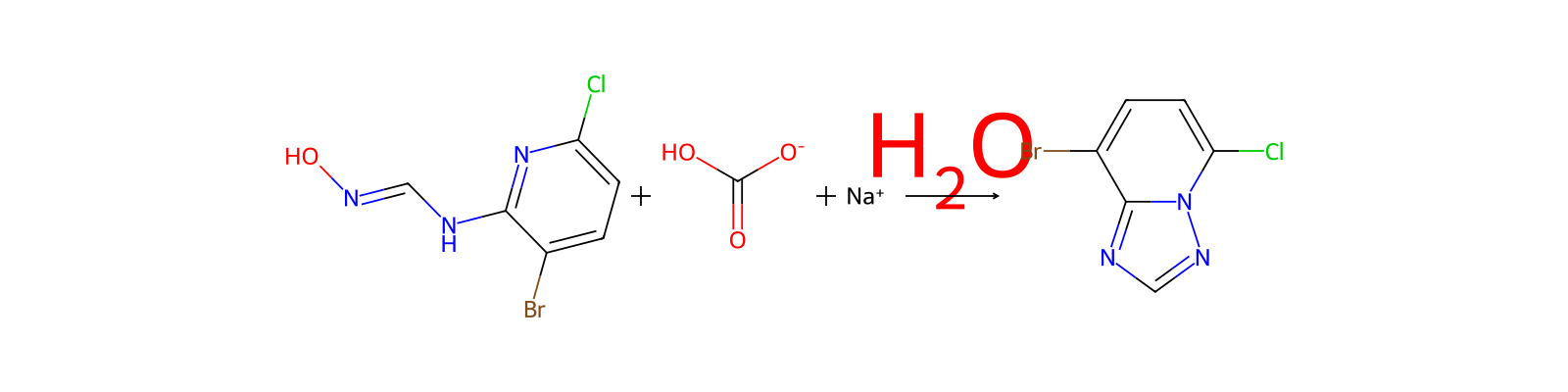
[Br:1][C:2]1[C:3]([NH:9][CH:10]=[N:11]O)=[N:4][C:5]([Cl:8])=[CH:6][CH:7]=1.C([O-])(O)=O.[Na+]>O>[Br:1][C:2]1[C:3]2[N:4]([N:11]=[CH:10][N:9]=2)[C:5]([Cl:8])=[CH:6][CH:7]=1Participants
4
Reactant 2


Product 1

Reagents, catalysts & solvents 1

Procedure
N-(3-Bromo-6-chloro-pyridin-2-yl)-N′-hydroxyformamidine (1.62 g, 6.47 mmol) is treated for one hour and 45 minutes with polyphosphoric acid (20 g) at 80° C. After cooling to room temperature, water (200 mL) is added to the reaction mixture. The resulting solution is brought to pH 8 by careful addition of solid NaHCO3 in small portions. The clear solution is extracted three times with dichloromethane. The organic phase is dried over MgSO4, filtered and evaporated. The solid residue (1.44 g) is purified by flash chromatography (silica gel, 4:4:0.7 petroleum ether: dichloromethane: ethyl acetate) to give the title compound (0.75 g) as a solid.
Workup
- extractionThe clear solution is extracted three times with dichloromethane
- dry with materialThe organic phase is dried over MgSO4
- filtrationfiltered
- customevaporated
- customThe solid residue (1.44 g) is purified by flash chromatography (silica gel, 4:4:0.7 petroleum ether: dichloromethane: ethyl acetate)
Sources & evidence
- ORD record
- ord-1901673f2742434fa20319fe3e43dd25
- Source dataset
- uspto-grants-2011_07
- Patent number
- US07977352B2
Reaction notes
Loading…