Potassium Iodide → 2-(4-Iodobutyl)-1H-isoindole-1,3(2H)-dione
Reaction equation

Br[CH2:2][CH2:3][CH2:4][CH2:5][N:6]1[C:10](=[O:11])[C:9]2=[CH:12][CH:13]=[CH:14][CH:15]=[C:8]2[C:7]1=[O:16].[I-:17].[K+]>CC(C)=O>[I:17][CH2:2][CH2:3][CH2:4][CH2:5][N:6]1[C:10](=[O:11])[C:9]2=[CH:12][CH:13]=[CH:14][CH:15]=[C:8]2[C:7]1=[O:16]Participants
4
Reactant 2

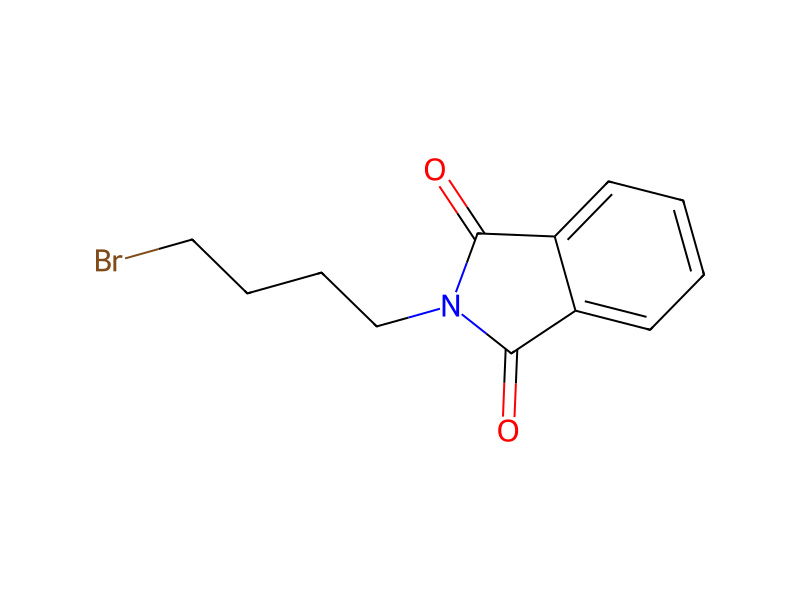
Product 1

Reagents, catalysts & solvents 1

Procedure
A solution of 5.0 g (0.018 mol) of N-(4-bromobutyl)phthalimide in 116 mL of acetone was treated with 20.7 g (0.125 mol) of potassium iodide and stirred at room temperature for 5 days. The reaction was filtered and the filtrate was diluted with 400 mL of ether, then filtered again through celite. The filtrate was concentrated at reduced pressure. The resulting solid was recrystallized from 300 mL of hexane (filtered hot and boiled down to 150 mL) to yield 4.0 g (68.6%) of 3 as white needles.
Workup
- filtrationThe reaction was filtered
- additionthe filtrate was diluted with 400 mL of ether
- filtrationfiltered again through celite
- concentrationThe filtrate was concentrated at reduced pressure
- customThe resulting solid was recrystallized from 300 mL of hexane (filtered hot and boiled down to 150 mL)
Sources & evidence
- ORD record
- ord-e267d595090e4041ba5504398bb926d8
- Source dataset
- uspto-grants-2002_11
- Patent number
- US06476199B1
Reaction notes
Loading…