HuagongsheHuagongshe Chemistry Print Report · For research reference only
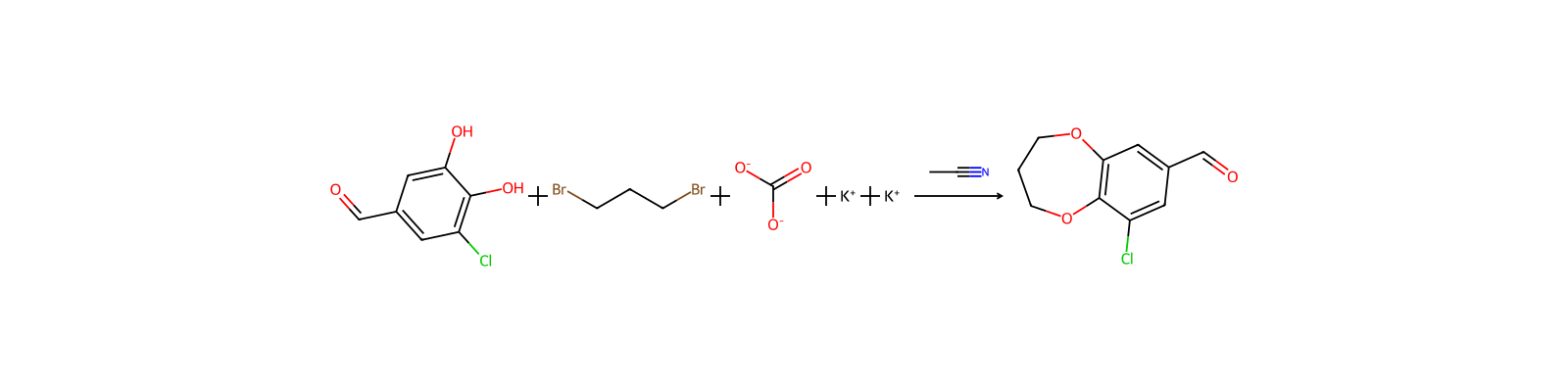
1,3-Dibromopropane → 9-chloro-3,4-dihydro-2H-1,5-benzodioxepine-7-carbaldehyde
Participants
| Role | Name | HCID | Charge |
|---|---|---|---|
| Reactant | 1,3-Dibromopropane | HCID 8001 | — |
| Reactant | Potassium Carbonate | HCID 11430 | — |
| Reactant | 3-Chloro-4,5-dihydroxybenzaldehyde | HCID 2468182 | — |
| Solvent | Acetonitrile | HCID 6342 | — |
| Product | 9-chloro-3,4-dihydro-2H-1,5-benzodioxepine-7-carbaldehyde | HCID 4962246 | — |
Reaction Steps
A mixture of 3-chloro-4,5-dihydroxy benzaldehyde (4.15 g), of 1,3-dibromopropane (4.71 g, 0.92 eq.) and potassium carbonate (8.28 g, 2.5 eq.) in acetonitrile (160 ml) was heated to 60° C. overnight. The mixture was allowed to cool to room temperature and filtered. The filtrate was concentrated under reduced pressure. The residue was purified by flash chromatography on silica (20% ethyl acetate in hexanes) to give the product as a white crystal. MS (m+1)=212.1
Provenance & Evidence
| DOI | 10.6084/m9.figshare.5104873.v1 |
|---|---|
| Patent number | US08722896B2 |
| Source dataset | uspto-grants-2014_05 |
| ORD ID | ord-5ea4580f0c9f4e5a95641458ceba33f3 |
| Source note | uspto-grants-2014_05 |