HCID 178418489, compound → DL-Arabinose
Reaction equation

[CH2:1]([OH:10])[C@@H:2]([C@H:4]([C@@H:6]([CH2:8][OH:9])[OH:7])[OH:5])[OH:3]>C(O)C>[CH2:1]([OH:10])[CH:2]([OH:3])[CH:4]([OH:5])[CH:6]([OH:7])[CH:8]=[O:9]Participants
Reactant 1
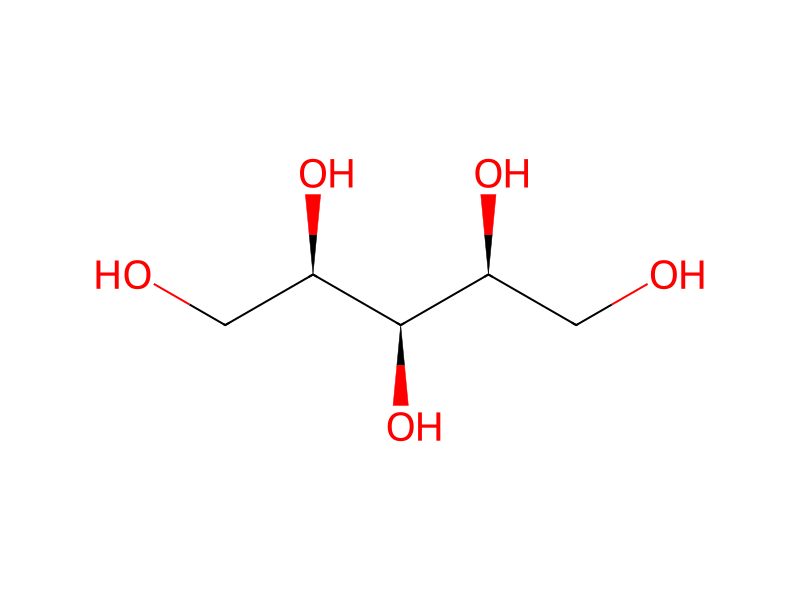
Product 1

Reagents, catalysts & solvents 1

Procedure
The two major chemicals of interest that can be produced from D-xylose by yeasts are ethanol and xylitol. It is known that under normal growth conditions, some pentose-fermenting yeasts (e.g. Pichia stipitis) produce mostly ethanol (Du Preez 1994; Schneider 1989); while others (e.g. Candida guilliermondii, Candida tropicalis) produce mainly xylitol as the end products (Barbosa et al. 1988; Gong et al. 1981). As an intermediate metabolite, xylitol is widely applied in food and pharmaceutical industries because of its equivalent sweetness to sucrose and high negative heat of solution (Borges 1991; Passon 1993), its anti-cariogenic and anti-infection effects (Pizzo et al. 2000; Sakai et al. 1996; Brown et al. 2004), and independent metabolism of insulin, therefore making it useful for diabetic patients (Salminen et al. 1989). Among the xylose-fermenting yeast, the genus Candida is one of the most efficient xylitol producers (Meyrial et al. 1991). Ojama demonstrated that C. guilliermondii VTT-C-71006 is an efficient xylitol producer. A xylitol yield of 0.74g/g xylose was obtained within 50 hours at an initial D-xylose concentration of 100g/1 (Ojama 1994).
Sources & evidence
- ORD record
- ord-f22713668cba480c91ed8d8701fd00a8
- Source dataset
- uspto-grants-2014_05
- Patent number
- US08728781B2
Reaction notes
Loading…